One video on your channel does numbers nobody expected, then the next one lands back near normal.
I re-pulled Toby's real view counts myself on 29 September 2026, alongside two other creators' cases.
By the end you will have the same check to run on your own channel.
Quick answer
- Read the video that came after the viral one, not just the hit. Toby, a small creator whose channel normally gets a few hundred views, had one hit 205,556 views (29 September 2026); his next upload got 377.
- Set the baseline first: the median, the middle number once you sort a channel's uploads low to high, is its own normal. Toby's median across his five earlier uploads is 271.
- The hit is 758.5 times that baseline (205,556 ÷ 271); the follow-up is only 1.39 times it (377 ÷ 271). The channel has been silent for 34 days since.
- Open the traffic source report (where views came from: search, suggested, home feed, or outside YouTube), then list what changed: topic, packaging (title plus thumbnail), format, timing, or an outside push.
- Two more real cases show the same drop (Ellis 294,000 to 11,000; a 930-subscriber channel studied by Paddy Galloway, 7.1 million to 3,500). Toby's own case still has open variables beyond language.
Check your own video: paste the link in the free outlier checker. It shows the maths and takes a second.
- The Video After a Viral Hit Is the Part Worth Reverse Engineering
- Why Some Videos Go Viral and the Next One Does Not
- A Channel's Own Median Sets the Baseline for Viral Video Analysis
- Isolating the One Variable That Changed Against That Baseline
- What Toby's Language Switch Rules Out, and What It Doesn't
- Telling Strategy Apart From Luck in a Viral Video
- Conclusion (What I Would Do)
- FAQ: Reverse Engineering a Viral Video
The Video After a Viral Hit Is the Part Worth Reverse Engineering
Toby's outlier video, meaning one that wildly beat his channel's own normal, had 205,556 views on 29 September 2026; his very next upload had only 377. I think the flop teaches more than the hit.
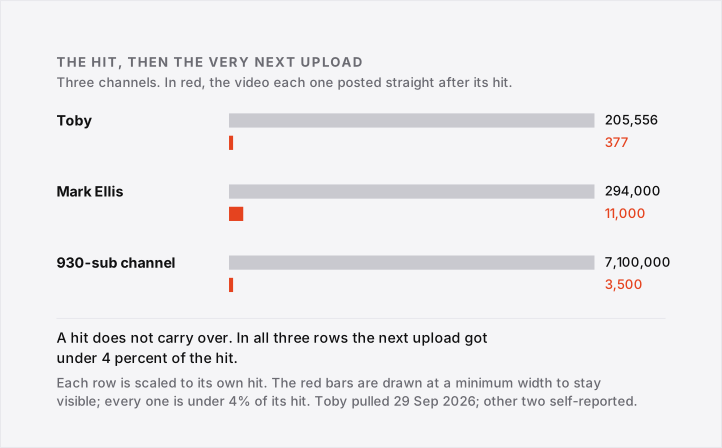
Three Channels, the Same Drop
- Toby: 205,556 on the hit, then 377, pulled 29 September 2026.
- Mark Ellis: 294,000 views on his iMac review, then just over 11,000 on the next one.
- A 930-subscriber channel Paddy Galloway studied: 7.1 million views, then 3,500 on the next upload.
Our own YouTube outlier breakdown measured Toby's video on 21 August 2026, when it read 115,963 views. By 29 September 2026 it had reached 205,556.
The Five Steps of the Two-Video Read
Call this the two-video read: judge the hit against the video right after it, never alone.
- Find the baseline: the median of the five to ten uploads before the hit. The channel analyzer computes it for every upload; the outlier checker scores one video.
- Divide the hit's views by that median.
- Open YouTube Studio's traffic source report, the free dashboard every channel gets, and read where the views actually came from.
- List every candidate that changed (topic, packaging, format, timing, an outside push), then note which ones the flop shares with the hit.
- Divide the follow-up's views by the same median. What is left is your best guess, not a proof.
Why Some Videos Go Viral and the Next One Does Not
Most videos don't carry a hit's audience forward. Our study of 27,985 videos found that after 53.4% of outliers, the next five uploads were back to normal.
After 24.4% the channel moved up 3x or more, against 5.0% after an ordinary video. A subscription is only permission to show someone your thumbnail, not a promise to watch.
Click-through rate, or CTR, is the share of people shown a thumbnail who actually click it.
Todd Beaupre, YouTube's own Senior Director of Growth and Discovery, said on Creator Insider that subscribers click through at roughly 10 percent or less.
That means even a channel's best videos see 90 percent of their own subscribers decide not to watch.
YouTube names this pattern itself. Its own performance help page lists one reason for less traffic afterward: "you had a few high-performing videos, or a video went 'viral' but those viewers didn't return to watch more".
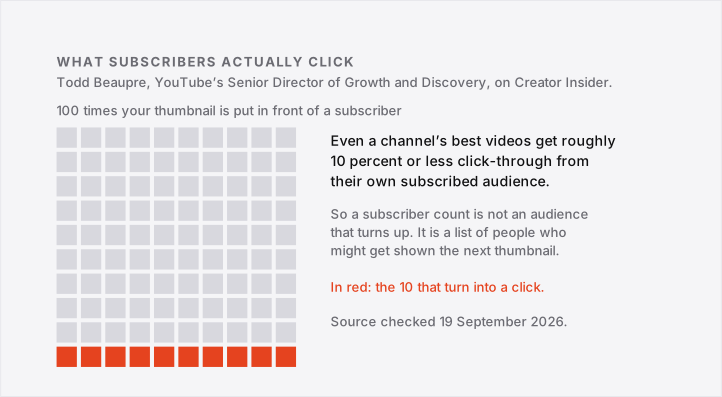
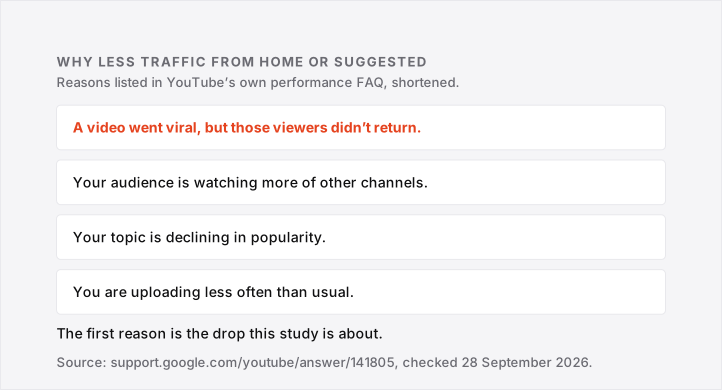
Subscribers Are Not a Guaranteed Audience
Impressions are the number of times YouTube put your thumbnail in front of somebody, whether or not they clicked it. YouTube tests a video with a small slice of viewers first, then expands only the ones who hold attention.
But the people a hit reaches came for that one topic, not for the channel itself.
Galloway's 930-subscriber channel gained 11,500 subscribers from its hit and still did only 3,500 views on the next upload. I think subscribers are reach, not an audience.
A Channel's Own Median Sets the Baseline for Viral Video Analysis
A channel's own baseline decides whether a video counts as unusual. That baseline is one number: the median, the middle value once uploads are sorted low to high.
Sorting Toby's five earlier uploads puts 271 in the middle, so 271 is his baseline.
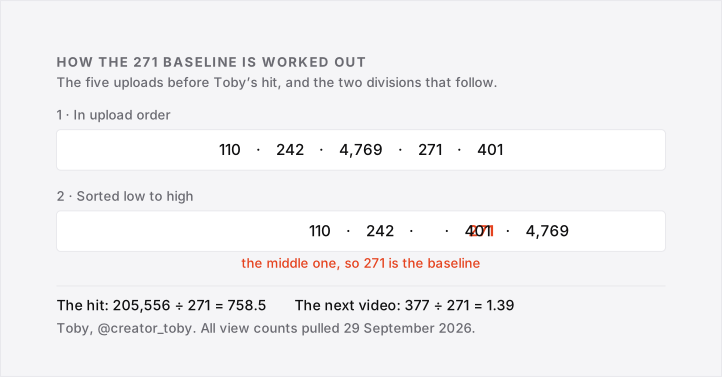
Toby's Median, Worked Out in Order
In upload order, Toby's five videos before the hit did 110, 242, 4,769, 271 views, and 401, all visible on his own upload history, pulled 29 September 2026.
Sorted low to high, that is 110, 242, 271, 401, 4,769. The middle one, 271, is the median.
I personally use the median, not the mean (the ordinary average), because one 4,769-view video drags the mean up to 1,159, more than four times the real normal.
An outlier is a video that wildly beats its own channel's median. We flag one once it clears 5 times that number.
Toby's hit clears that bar hard: 205,556 ÷ 271 = 758.5. His follow-up, divided by the same 271, is only 377 ÷ 271 = 1.39.
These figures differ from our breakdown's frozen 21 August ones (228 median, 508.6x) because the baseline videos kept growing too.
Where the 5x Bar Comes From
| Tool | Baseline it compares against | Flag bar |
|---|---|---|
| vidIQ | Channel average over a similar timeframe | Not stated |
| ViewStats | Last 10 uploads averaged | Not stated |
| OutlierKit | Average of the last 30 to 50 uploads | 3x |
| OverseerOS | Median of recent uploads, candidate excluded | Not stated |
| Breakdown Theory | Median of the uploads before it | 5x flags an outlier; 10x or more is a very big one |
Our bar is 5x on the outlier score: a video's views divided by its channel's median. The tools above, or these free options, will find one for you.
Isolating the One Variable That Changed Against That Baseline
Isolating the variable starts with the traffic source report inside YouTube Studio, which YouTube documents on its own help page.
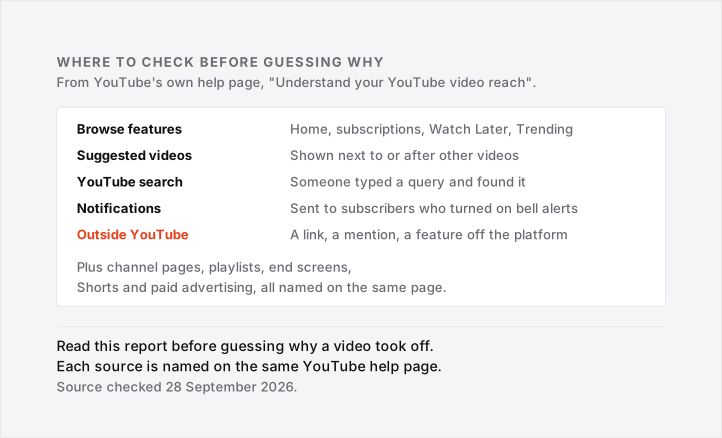
Start From the Traffic Source Report
A traffic source is where a view actually came from: the home feed, search, off YouTube, or a notification.
- Topic: what the video is about.
- Packaging: the title and thumbnail pair a viewer sees in the feed.
- Format: long-form, Shorts, live, or a series entry.
- Timing: the day, the hour, or what else was happening that week.
- An outside push: a mention, a link, or a feature off YouTube.
TubeAnalytics says check the traffic source first, then change only one layer at a time, never several together.
Packaging Is the Title and Thumbnail Pair
Derek Muller of Veritasium, in his clickbait video (about 8.3 million views), says he changed a title and thumbnail to "these are the asteroids to worry about".
He says it then reached "nearly 10 times as many people as it otherwise would have".
Also, Ali Abdaal reports a separate thumbnail swap moving a video from about 300,000 to about 1.1 million views. I think packaging is the cheapest thing to test.
If packaging is your candidate, start by changing a thumbnail on a mid-performer, never your strongest video.
What Toby's Language Switch Rules Out, and What It Doesn't
Toby's five uploads before the hit are in German. The hit and the flop that followed it are both in English.
So the switch cannot be the whole reason the hit worked. It may still have helped; a shared feature just cannot explain why only one took off.
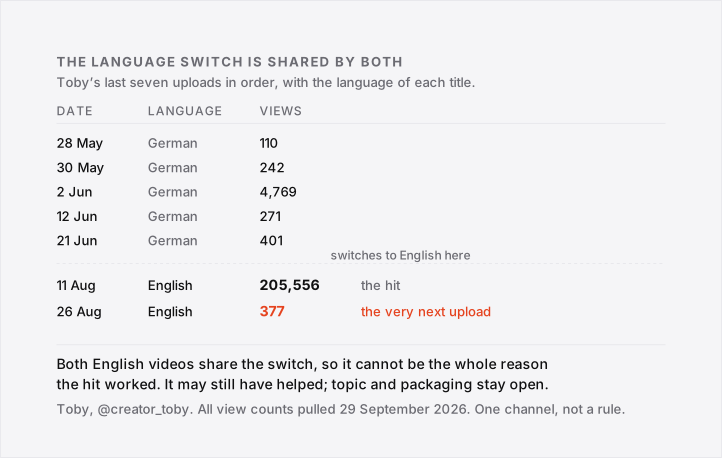
What Is Still Open
One example: "Wie ich auf die langweiligste Art online Geld verdient hab," roughly "how I made money online the most boring way possible," was typical of the German run.
The hit, "Taking a step back from Claude," and the flop, "How I made ChatGPT boost my clients business," are both English.
- Still open: the specific topic and its promise, apart from the language it's told in.
- Still open: packaging. We never studied the flop's thumbnail against the hit's.
- Still open: the upload gap. The hit landed 51 days after Toby's last German video; the flop landed only 15 days after the hit.
- Cannot see: Toby's own traffic source report. That lives inside his private YouTube Studio, not anywhere we can check.
This is one channel. Breakdown Theory has now published two YouTube outlier breakdowns, Toby's and Davmanity's, and two cases still is not a pattern across YouTube.
The channel has posted nothing in the 34 days since the flop, measured 29 September 2026. I personally would not read anything into that silence yet.
Telling Strategy Apart From Luck in a Viral Video
Strategy and luck explain two different parts of a viral video, and mixing them up is why creators chase the wrong lesson from one hit.
Jesser's NBA-marathon format is the clearest repeatable case here, and it ran four times.
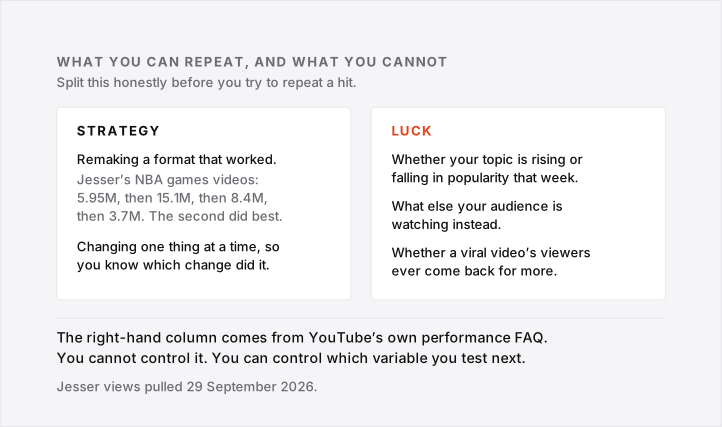
Repeating the Format Is the Replicable Part
Strategy is repeating the same format on purpose. Luck is which video the recommendation system decides to push, and how much outside interest turns up that week.
- Repeatable: Jesser's about 5.95 million views on the first NBA-marathon video, about 15.1 million on the second, 49 days later.
- The format ran twice more: about 8.4 million on the third, then about 3.7 million on the fourth, nearly four years after the second.
- I think the format is what repeats; I have not found Jesser explaining the later numbers, so I won't guess.
Conclusion (What I Would Do)
I would open the channel analyzer on my own channel this week and sort by score. Then I would read the upload right after my top one, using the two-video read.
This study is the closest thing on this site to a free sample of the newsletter. A full breakdown like it lands straight in your inbox.
FAQ: Reverse Engineering a Viral Video
How long should I wait before calling a video a flop?
GuardMyVideos calls a video underperforming once it sits below 30 percent of the channel's average after 14 days. That is a date to judge by, instead of refreshing hourly.
Does taking a break from uploading hurt your views?
Not by length, according to YouTube itself. Its own help page says it "studied thousands of channels that took a break and found no correlation between break length and changes in views".
But the same page still lists uploading less often as a reason for less home and suggested traffic.
Why did my video stop getting views after 48 hours?
That cliff is real: a vidIQ commenter went from 400 views an hour to 30 at the 48-hour mark. It often means the test audience stopped watching, though that is one viewer's report, not a lab result.
Can ChatGPT analyse a YouTube video for me?
It can read a transcript and describe the structure. It cannot see impressions, click-through rate, or the traffic source report, where the real answer to a spike lives.
What is the 7 second rule on YouTube?
I could not find any official YouTube source for a "7 second rule." What YouTube does publish is the traffic source split inside Studio, the real place to look instead of that folklore.