One of your videos beat your normal by 10x, or a rival's did, and the next upload sank. Was that luck, or something you can repeat?
I split the long videos of 388 channels into older and newer halves by upload date. Then I compared them with a world where outliers are pure luck.
You will see which part of an outlier repeats, and how to measure it on your own channel.
Quick answer
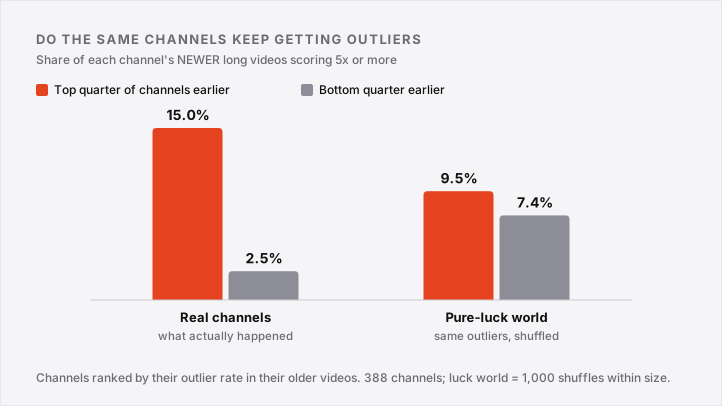
- Partly. Of 388 channels, the quarter with the most outliers (videos at 5x their channel's normal) in older uploads hit one on 15.0% of newer videos. The bottom quarter hit 2.5%.
- Pure luck would give 9.5% and 7.4%. That luck world shuffles the same outlier labels across same-size channels 1,000 times.
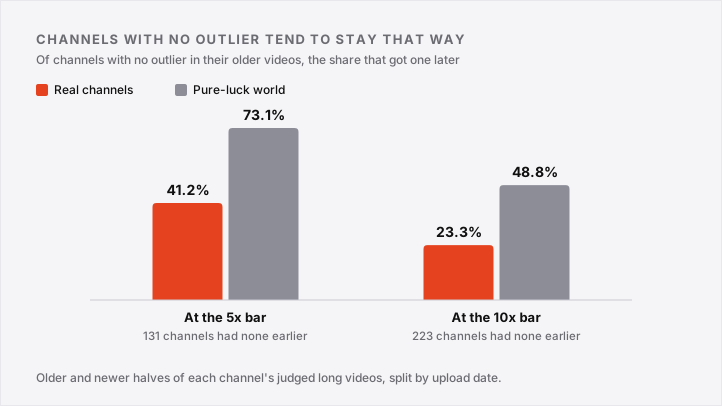
- Channels with no outlier get one later less often than luck predicts: 41.2%, against 73.1% in the luck world.
- Which video pops is hard to call: 11 of 16 title features showed no reliable signal, and 44.8% of outliers came after a dip in the channel's normal, against 32.2% of ordinary videos.
- Persistence shows channels differ, not that the difference is skill; a spikier format, a niche or small view counts can persist too.
Check your own video: paste the link in the free outlier checker. It shows the maths and takes a second.
- YouTube Outliers Keep Landing on the Same Channels, More Than Luck Allows
- Channels Without an Outlier Get One Less Often Than Luck Predicts
- About Half of YouTube Outliers Fall Back to Normal Within Five Uploads
- Most Title Features Do Not Predict Which YouTube Video Goes Viral
- Two Channels That Repeated a Viral Video and Two That Never Did
- Why Outlier Persistence Does Not Prove YouTube Success Is Skill
- What Creators Report After Blowing Up on YouTube Once
- Conclusion (What I Would Do)
- FAQ: YouTube Outliers and Luck
YouTube Outliers Keep Landing on the Same Channels, More Than Luck Allows
YouTube outliers keep landing on the same channels. The top quarter by outlier rate in older videos hit 5x on 15.0% of newer videos, the bottom quarter 2.5%. Pure luck would give 9.5% and 7.4%.
The Persistence Test in Plain Words
I split each channel's long videos (Shorts left out; 16,331 videos across 388 channels) by upload date into an older half and a newer half.
Then I ranked channels by outliers in the older half and checked the newer half. If outliers were luck, the older half could not predict the newer one.
An outlier here is a video with 5x the median views of the 10 uploads before it. The median is the middle value of those ten when sorted, so one huge video cannot drag it up. That median is the channel's baseline, its normal.
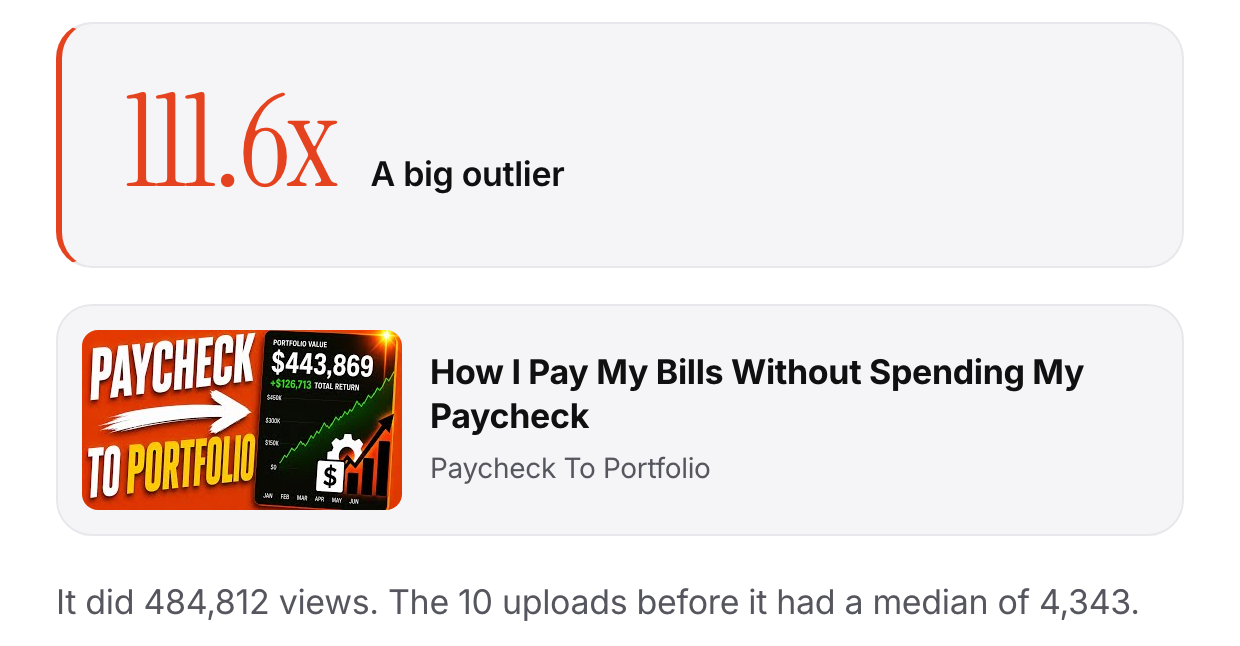
Paycheck To Portfolio's top video had 484,812 views against a median of 4,343. So 484,812 ÷ 4,343 = 111.6x. The outlier rate is the share of a channel's videos that are outliers.
The Luck World It Is Compared Against
To judge the gap, I built a luck world. It shuffles every outlier label across the videos of a channel-size group, 1,000 times.
In that world a channel's past says nothing about its future. Its top and bottom quarters still differ a little, only because size groups differ in how often outliers happen.
- At the 5x bar: 15.0% against 2.5%. Luck world: 9.5% against 7.4%.
- At the stricter 10x bar: 8.3% against 1.6%. Luck world: 5.0% against 3.5%.
Channels Without an Outlier Get One Less Often Than Luck Predicts
Channels without an outlier get one later less often than luck predicts. Of 131 channels with no 5x video in their older half, 41.2% got one later. In the luck world, 73.1% would have.
Channels With No Outlier Fall Short of Luck
- At the 10x bar: 23.3% of 223 channels got one later. Luck world: 48.8%.
- By size, real vs luck: under 10k 61.9% vs 85.7%; 10k to 100k 52.4% vs 88.9%; 100k to 1M 50.0% vs 76.2%; over 1M 21.6% vs 63.3%. Under 10k, the gap is within luck's range.
The Correlation Holds at Every Channel Size
A correlation is a score for how well one half predicts the other. It runs from -1 to 1: 0 means the older half says nothing about the newer one, 1 means it predicts it perfectly.
For a channel's older and newer outlier rate it is 0.49. In the luck world it is about 0.13, and no shuffle reached 0.49.
- By size: strongest over 1M subscribers (0.70), weakest at 100k to 1M (0.23; only 1 luck shuffle in 40 got past 0.215).
About Half of YouTube Outliers Fall Back to Normal Within Five Uploads
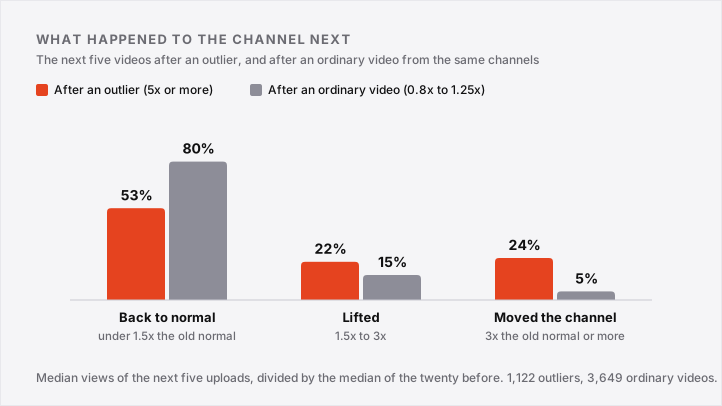
About half of YouTube outliers fall back to normal. After 49.3% of outliers, the next five uploads had a median under 1.5x the channel's old normal. After an ordinary video (0.8x to 1.25x its normal), the figure is 79.6%.
Half of Spikes Do Not Lift the Channel
I think this cuts both ways: half of hits fade, but hits lift channels more than ordinary videos do.
- Moved the channel to 3x or more: 26.1% after an outlier, 4.6% after an ordinary video.
- The chart's stricter normal (the 20 uploads before): 53.4% back to normal, against 80.5%.
Outliers Often Sit on a Dipped Baseline
44.8% of outliers had a baseline in a dip: the median of the ten uploads before it was under 0.8x the median of the ten before those. For ordinary videos the share is 32.2%.
So part of an outlier is a low normal at that moment, which inflates the multiple.
Most Title Features Do Not Predict Which YouTube Video Goes Viral
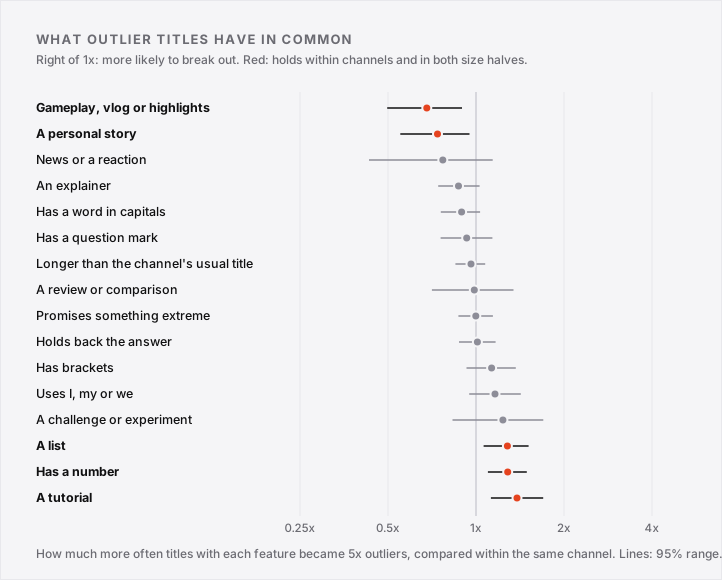
Most title features do not predict which YouTube video goes viral within a channel. Of 16 features tested on the same 16,331 videos, 11 showed no reliable signal. The 5 that held were modest, 0.68x to 1.38x.
The Five Title Features That Held, Modestly
Each figure compares titles inside one channel. "1.28x as likely" means 28% more often a 5x outlier.
- Has a number: 1.28x as likely.
- A tutorial: 1.38x.
- A list: 1.28x.
- A personal story: 0.74x, so less likely.
- Gameplay, vlog or highlights: 0.68x, so less likely.
With 16 tests, about one could pass by chance, so I read these as hints.
Outside Research Finds the Same Split
- Salganik, Dodds and Watts (Science, 2006): 14,341 people, 48 songs, 8 separate worlds. Quality set a range, but the winner inside it was unpredictable. That is music, not YouTube.
- Martin et al. 2016 on Twitter: content features alone had negligible predictive power, but adding the poster's past success let it explain 42% to 48% of the differences in how far posts spread.
That mirrors my results: a video is hard to call, a channel's history is not.
Two Channels That Repeated a Viral Video and Two That Never Did
Some channels repeat a viral video and others never do. In this 388-channel study, one had 12 outliers in 50 videos, one had 4 in 47, and two had one each. Views pulled 2 to 3 October 2026.
One Clear Repeater and One Borderline Repeater
The Geography Bible (science) has 248,000 subscribers. Dr. Chris Pieton (pelvic floor physio) has 26,000.
- The Geography Bible: a 24% rate, 6 outliers in each half, on baselines of 36k to 81k views. Four: 57.4x, 49.5x, 45.2x, 6.9x.
- Its series: 5 of the 12 are "What on Earth is..." or "30 Geography Facts" videos, a format that repeats.
- Dr. Chris Pieton: 8.5% against the median channel's 6.4%: 10.2x, 21.1x, 54.4x and 9.7x.
- Why borderline: 3 of the 4 came in the older half, only 1 in the newer.
Two Channels With One Outlier and Nothing Else
Paycheck To Portfolio (finance) has 45,200 subscribers. Taylor Atwood (powerlifting) has 20,200.
- Paycheck To Portfolio: 111.6x on 2 October. Nothing else among 46 judged videos passed 3.4x.
- Taylor Atwood: 53,388 views over a 4,783.5 median is 11.2x. No other video among 50 reached 5x.
- After the hit: Paycheck's next five uploads had a median of 5,463 views, about 1.26x its normal. Atwood's had 12,723, about 2.7x: a real lift, no repeat.
Why Outlier Persistence Does Not Prove YouTube Success Is Skill
Outlier persistence proves channels differ, not that the difference is skill. A spikier format or niche, or the wider swings of small channels, can persist without extra skill.
Four Things the Persistence Test Cannot Separate
- Format and niche: a list or clip format can be spikier by nature, so a channel can persist without being better.
- Small channels swing further: 11.2% of videos on channels under 10,000 subscribers hit 5x, against 4.9% over 1,000,000.
- Regression to the mean: extreme results drift back toward average. The top quarter was picked at 22.4% in its older half and fell to 15.0%.
- The sample: channels came from search results, which favours those already doing well, and needed 40+ uploads, which drops channels that stopped.
Other Persistence Tests, With and Without a Luck Baseline
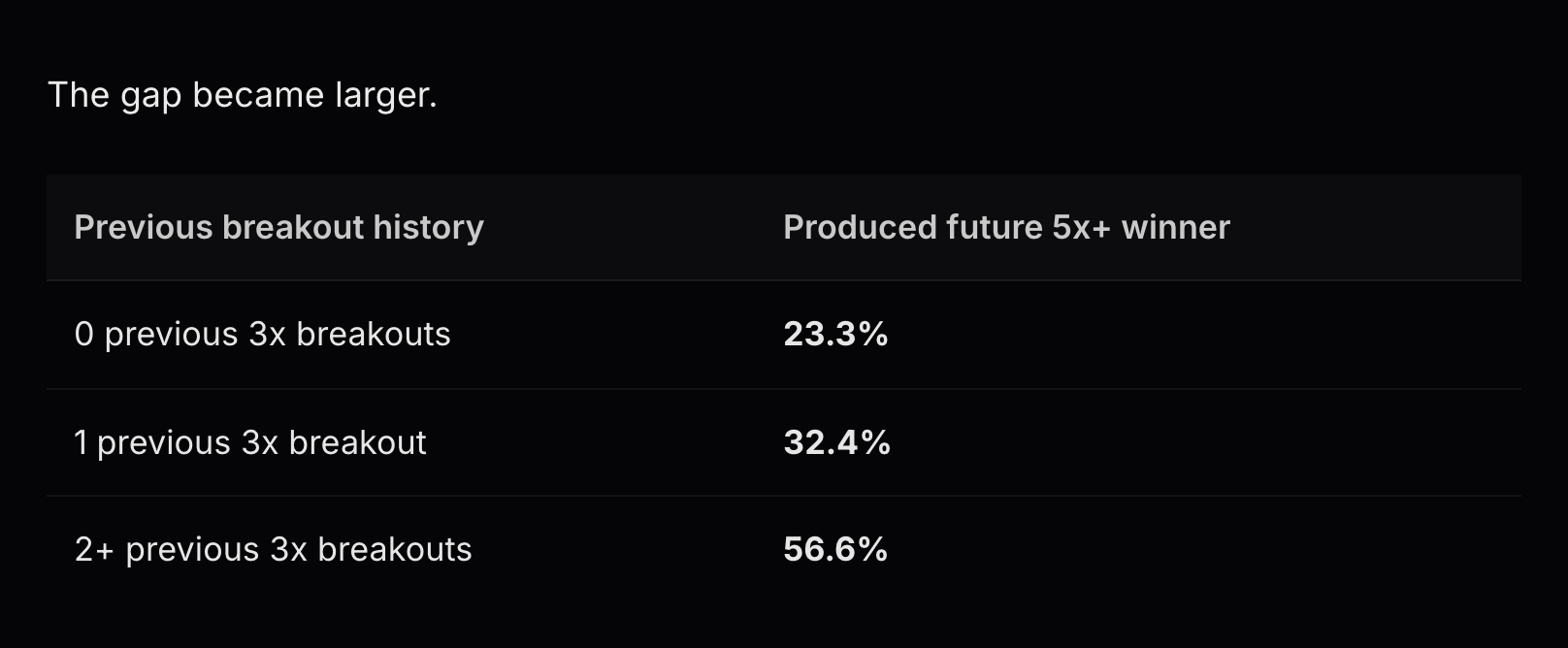
OverseerOS (19 September 2026) grouped 241 channels by earlier 3x breakouts, then checked for a 5x in the next 10 videos: 56.6% with two or more got one, against 32.4% with one. I found no shuffled luck baseline in it.
Garimella and West, 2019 used a shuffle test on Twitter: 59% to 86% of users had hot streaks, runs of unusually popular tweets, against under 30% after shuffling.
Their preliminary YouTube check found the effect did not hold for most users.
Every Sunday I take one outlier apart in a YouTube outlier breakdown to separate luck from strategy. Free, one email. See the Toby and Davmanity breakdowns for examples.
What Creators Report After Blowing Up on YouTube Once
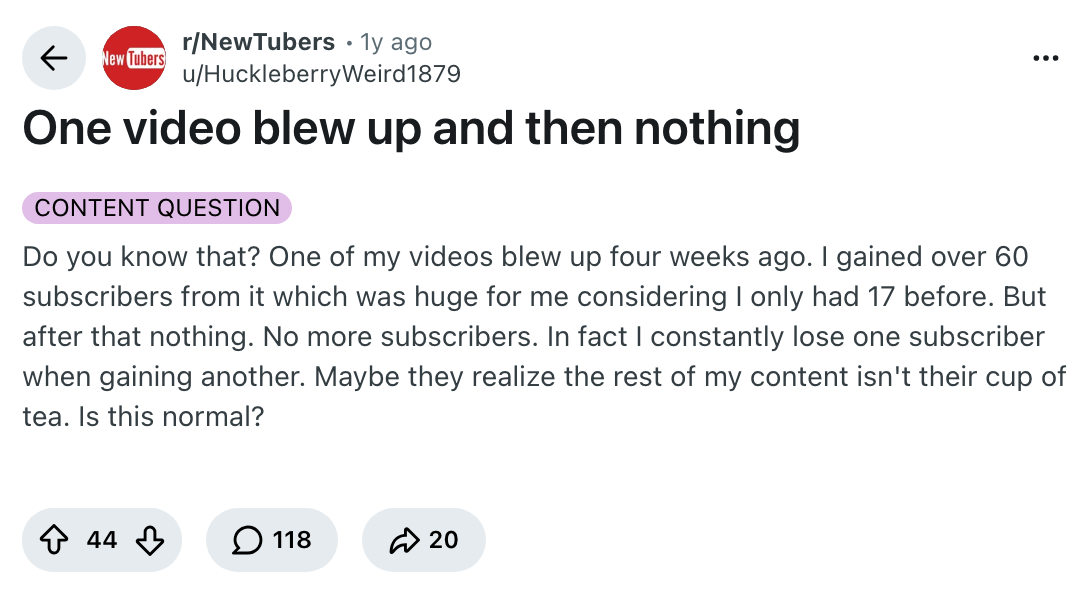
Creators who blow up on YouTube once describe the same sequence: a spike, then follow-ups at a small fraction of the hit. These are self-reports, so I count them as stories, not data.
One Hit, Then Nothing
- One creator on r/NewTubers: "My 4th video hit 140k views." Every video since, they say, has struggled to reach 500.
- A reply in the same thread: "The first time I had a really huge video the one that followed only got 1% the number of views."
- Another r/NewTubers poster: "I gained over 60 subscribers from it which was huge for me considering I only had 17 before." Then: "But after that nothing."
A Consistent System Creates More Chances
A creator on r/PartneredYoutube: "A consistent system creates the 'surface area' for luck to happen."
Conclusion (What I Would Do)
I think one hit is luck, and a channel's outlier rate is a trait worth measuring. Measure yours over an older and a newer half this week.
- List your last 40 or so long uploads in date order, Shorts left out, and split them into an older and a newer half.
- Paste each into the free outlier checker and mark every video at 5x or more. Fewer than 10 earlier uploads gives a shakier score.
- Outlier rate per half is outliers divided by videos in that half. Three outliers in 20 videos is a 15% rate.
- Outliers in both halves: look for what they share, such as a format or topic.
- One outlier and nothing since: treat it as luck until a second arrives. None in either half: I would try a tutorial or list format before reworking titles.
FAQ: YouTube Outliers and Luck
Is YouTube based on luck?
Partly. YouTube Help lists topic interest, competition and seasonality as reasons views differ between videos. Still, a channel's outlier rate persists: the top quarter hit 5x on 15.0% of newer videos, the bottom 2.5%.
Is 10,000 views considered viral?
Not by itself. Viral is relative to a channel's normal, not a fixed count. In our own YouTube outlier breakdown on Toby, a channel that usually got 228 views reached 115,963 by 21 August 2026.
Does YouTube punish you for gaps between uploads?
Not according to YouTube. Todd Beaupré said at VidCon 2026 that its study of millions of channels found virtually no relationship between upload gaps and view changes (Yahoo report).
Do big YouTubers think going viral is luck?
Even MrBeast allows for chance. He told TIME he can make almost anything go viral. His internal handbook, per Scrivner's summary, says that if a strong idea has only a 50/50 chance of working, write another.