Davmanity's channel normally gets about 19,810 views a video. That is the median of its other four uploads.
But "8 Terrifying Facts About Time" got 1,387,707 views when I checked it on 14 September 2026.
That is roughly 70 times more.
So let's look at the packaging, the channel behind it, the search demand it never had, and the rest of the edit, and see if there are things other creators can replicate for better views.
How the Video Performed
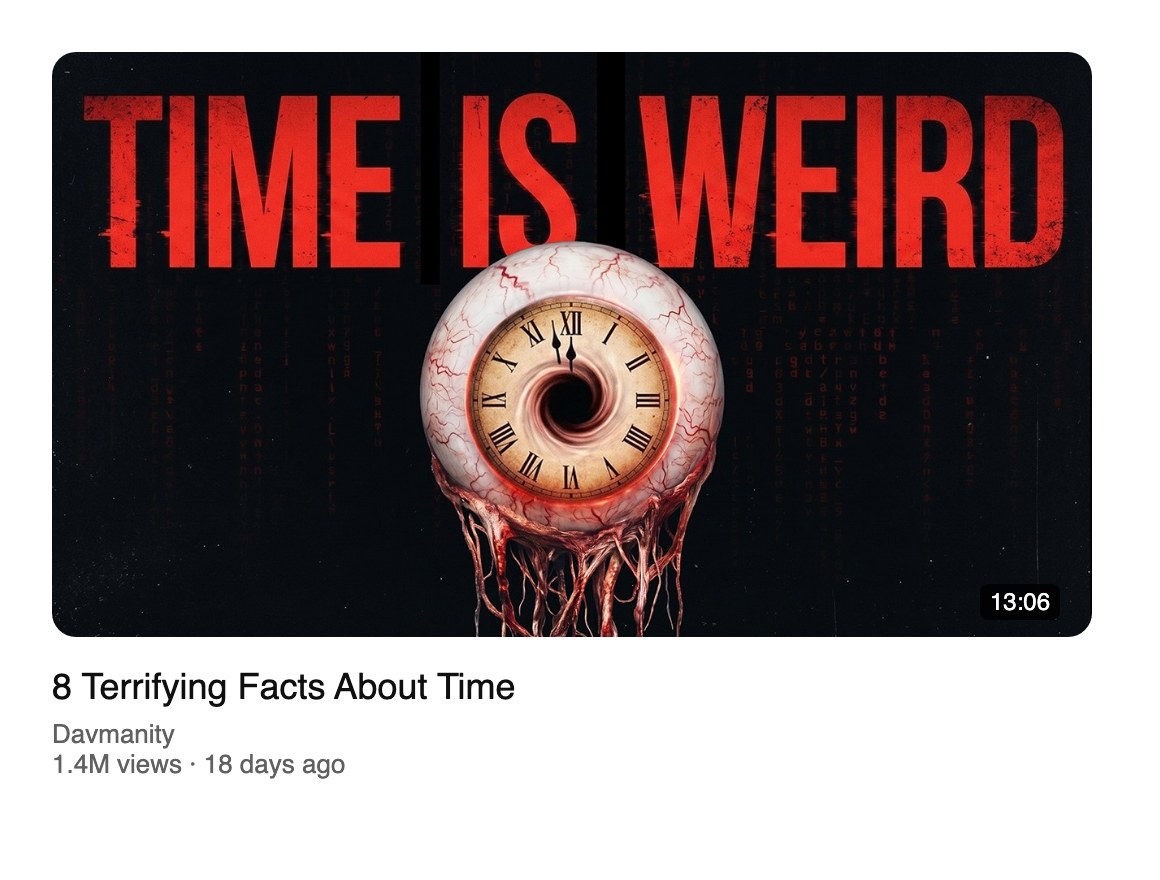
The video runs 13 minutes and 6 seconds. It had 1,387,707 views, 16,714 likes and 861 comments when I checked it, 17.7 days after upload.
The channel is called Davmanity, on the handle @Dumanity222. It has five uploads total.
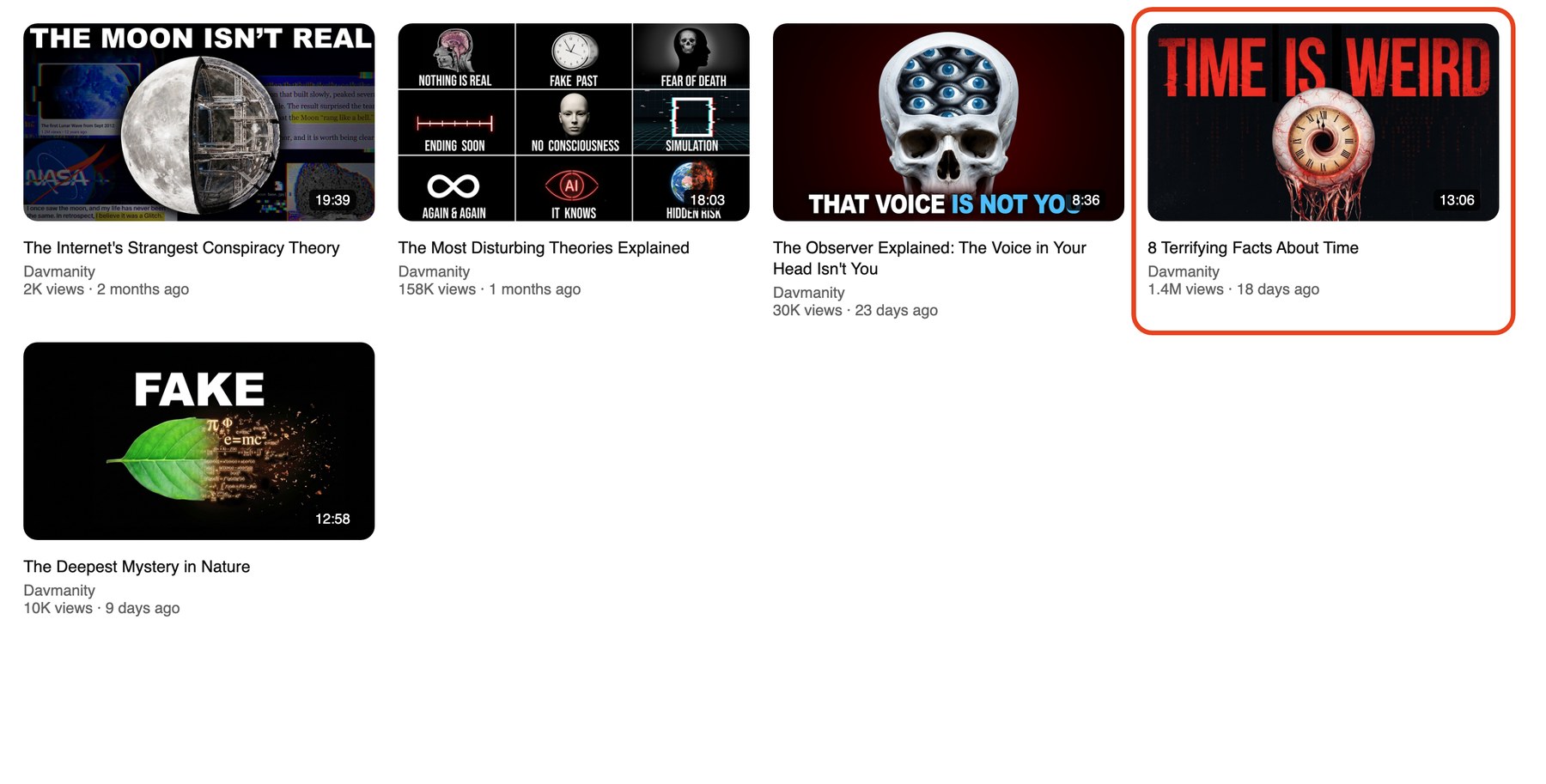
Here is every video on the channel, oldest first. Every view count in this breakdown is what I recorded on 14 September 2026, and all of them have kept climbing since:
- "The Internet's Strangest Conspiracy Theory" (4 July 2026), 2,414 views
- "The Most Disturbing Theories Explained" (8 August 2026), 158,155 views
- "The Observer Explained: The Voice in Your Head Isn't You" (22 August 2026), 29,613 views
- "8 Terrifying Facts About Time" (27 August 2026), the outlier, 1,387,707 views
- "The Deepest Mystery in Nature" (5 September 2026), 10,007 views
So the channel's normal range, without the outlier, is 2,414 to 158,155 views. The median of those four is 19,810.
Only one video has come out since the outlier, and it landed at 10,007 views, nowhere near the spike.
There is a pattern worth flagging early though. Two of these five videos number their facts from the very first line, and those two are the channel's two best performers.
I unpack that fully in section 8. But first I want to know who is actually behind this channel, because that turns out to matter.
My verdict is that this is a genuine outlier. One upload after it cannot tell us if it repeats, but the proof in section 6 tells us more than waiting ever could.
Who Is Davmanity?
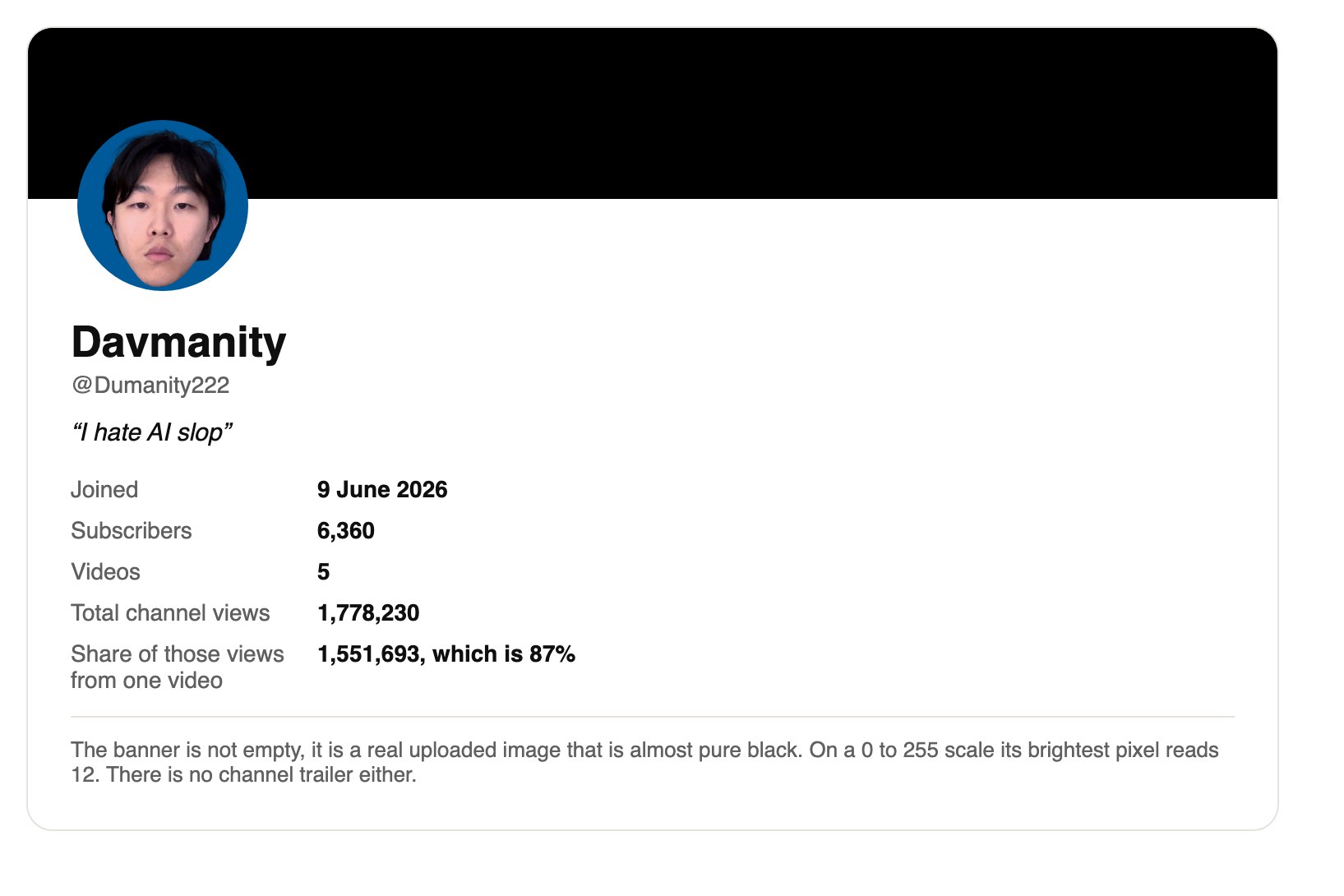
Davmanity joined YouTube on 9 June 2026. That makes the channel a little over three months old on the day I checked it, 20 September 2026.
- Joined 9 June 2026.
- 6,360 subscribers across 5 uploads.
- 1,778,230 total channel views.
- 1,551,693 of those, or 87%, come from this one video.
The channel bio is four words: "I hate AI slop".
The banner is not empty air. It is a real uploaded image, but it is almost pure black. Its brightest pixel reads 12 on a 0 to 255 scale.
There is no channel trailer either.
So a channel that has earned 1.78 million views has built no brand infrastructure at all. Nothing welcomes a new visitor, and nothing tells them to come back.
That is the same decision as the zero calls to action inside the video itself. It is just made once at channel level instead of 786 times inside one video.
My verdict is that Davmanity spent everything on the video and nothing on turning its traffic into a following. That is consistent, not careless.
Where the Views Came From (Expected)
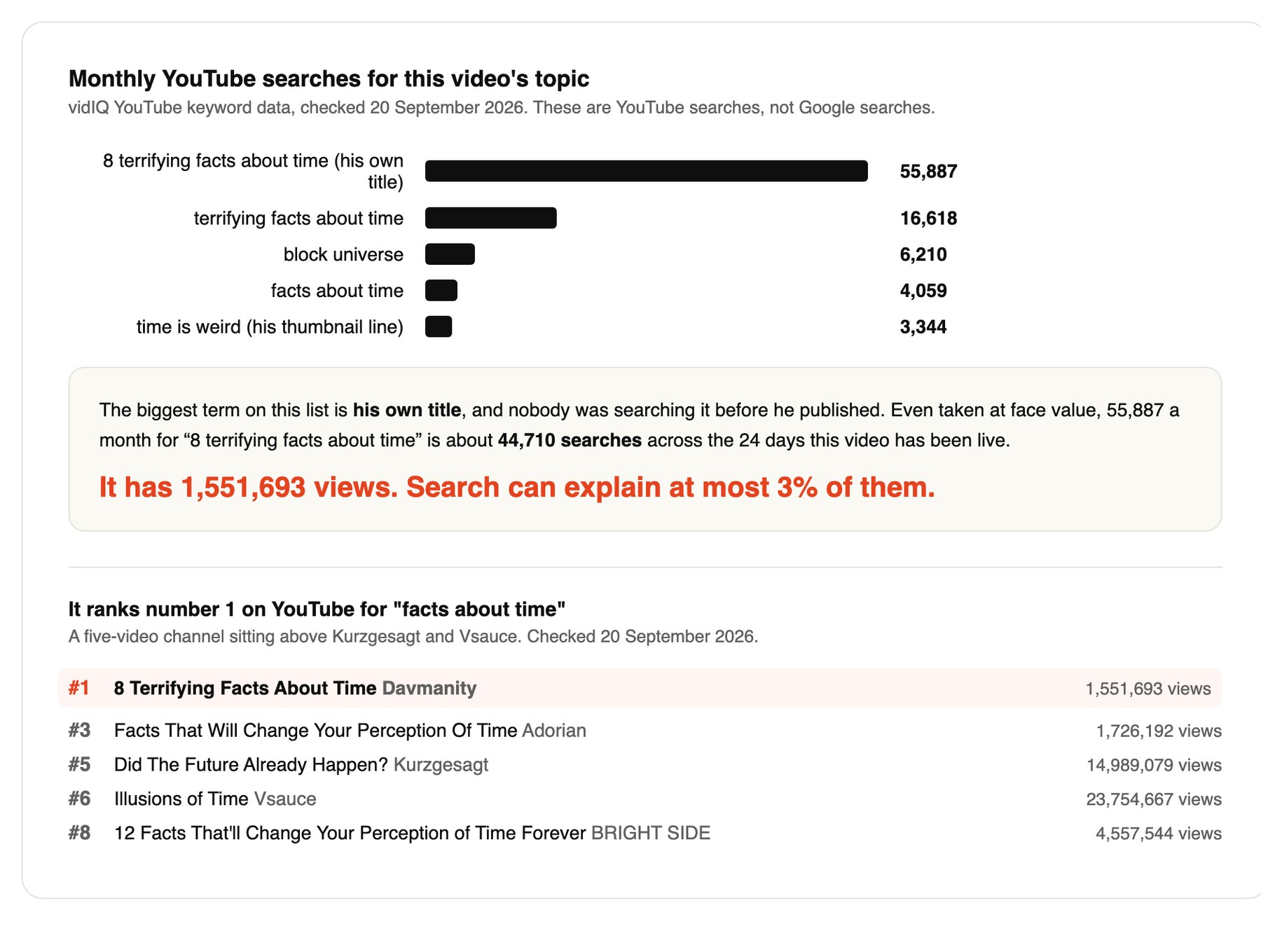
I checked the real YouTube search volume behind this title, using vidIQ, on 20 September 2026.
I do not have his YouTube Studio, so none of this is measured traffic. It is what the search demand allows, checked against what the video actually did.
An earlier version of this piece used Google search volume and reported 390 searches a month. That was the wrong platform to measure.
On YouTube, the same phrase does 4,059. All the numbers here come from vidIQ's YouTube data.
- "8 terrifying facts about time", his own title: 55,887 searches a month on YouTube, according to vidIQ.
- "terrifying facts about time": 16,618 a month.
- "block universe": 6,210 a month.
- "facts about time": 4,059 a month.
- "time is weird", his thumbnail line: 3,344 a month.
- "does time exist", a bigger but different topic: 3,495 a month.
The biggest term on this whole list is his own title, "8 terrifying facts about time", at 55,887 a month.
That term did not exist as a search before he published it. The video did not capture demand, it created it.
Even taken at face value, that is about 44,710 searches across the video's 24-day life, against 1,551,693 views.
So search still caps at about 3% of what happened here. That is the strongest single piece of evidence in this whole breakdown.
It won on browse and suggested. There, the thumbnail and the title are not one factor among several, they are the entire mechanism.
The term he created is now low-competition and high-opportunity, exactly why English Achieve tried to take it eleven days later.
There is a trophy hiding in the same data, and I want to be honest about what it is worth. This video ranks number 1 on YouTube for "facts about time".
That beats Kurzgesagt's 14,989,079-view video and Vsauce's 23,754,667-view video on the same topic.
But that keyword only gets 4,059 searches a month on YouTube. Ranking first there is worth having, but it is nowhere near what actually drove this video's views.
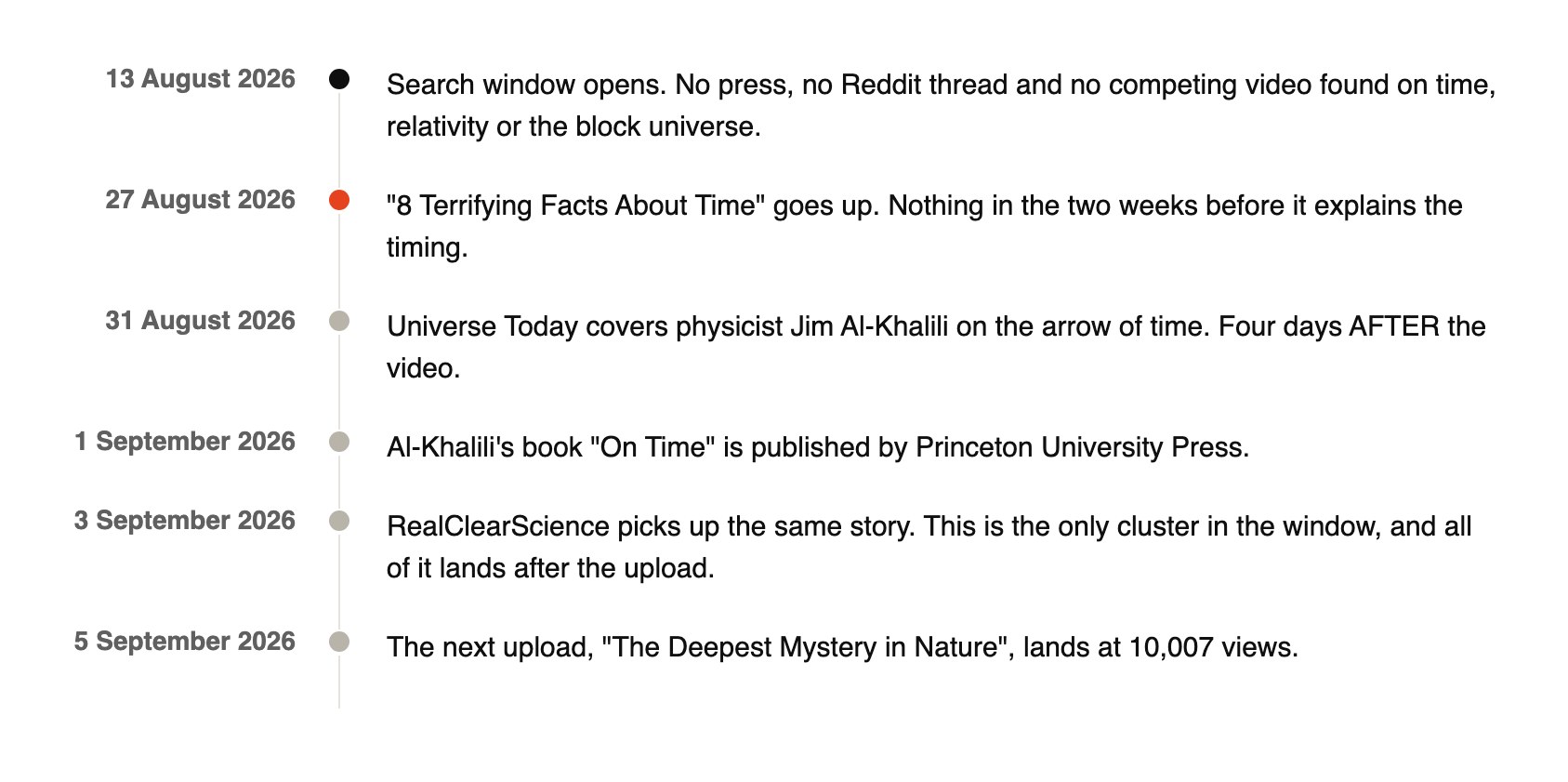
I also checked whether a news wave explains any of this, the two weeks before and after 27 August 2026.
- 13 August 2026: the search window opens, and nothing on topic exists yet.
- 27 August 2026: the video goes up, with no lead-up news anywhere.
- 31 August to 3 September 2026: Universe Today and RealClearScience cover physicist Jim Al-Khalili's new book on time, four to seven days after the video.
So the only cluster I could find landed after the upload, not before it. Davmanity could not have timed this to ride a wave, because there was no wave yet when he posted.
I also checked his other platforms. He lists no external links anywhere, and the video's description only carries topic keywords like philosophy and physics.
I could not find his profiles on any other platform, like TikTok, X, LinkedIn, Threads, or a Discord or any other community.
A big following somewhere else would lift every video on the channel, not just one. Four of the five sit far below the outlier, so there is no such following to credit.
My verdict is that none of the three outside explanations survive. Search cannot explain it, no news wave lifted it, and no other platform fed it.
Whatever did this came from YouTube's own recommendations, working off the packaging alone.
The Thumbnail Breakdown
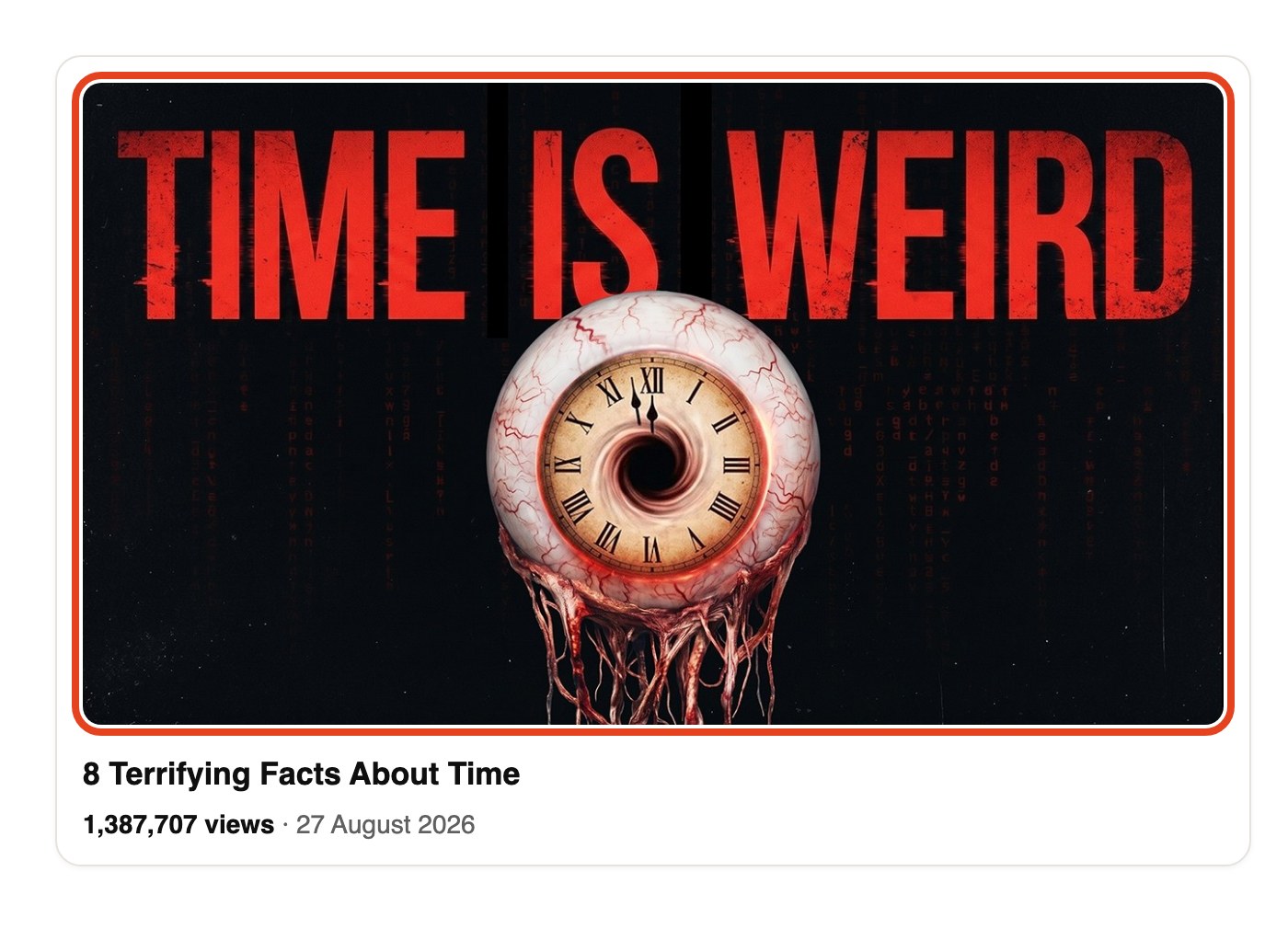
The thumbnail has just two elements. A distressed red headline reading "TIME IS WEIRD", and one surreal object: a bloodshot eyeball with a working clock face built into the iris.
The background is almost empty black with a faint reddish texture. Nothing else competes for attention.
Paddy Galloway says thumbnail text should stay short. He told Creator Science, "I would stay away from having over five or six words".
His own channel, he says, usually runs "two or three words, maybe four". "TIME IS WEIRD" is three words, so this follows that rule.
Galloway also argues for fewer elements. A write-up of his guide on Marketing Examined puts his rule at "3 or less elements, easy to glance". This thumbnail has two.
Here is how I think the click actually happens, and I want to flag this as my own reading, not a sourced law. A viewer sees the thumbnail first and gets a rough feeling, dread, something wrong with an eye and a clock.
They jump to the title, "8 Terrifying Facts About Time", which reframes that dread as eight countable pieces of knowledge.
Then they go back to the thumbnail and re-read it with the title's meaning loaded in. The clock-eye now reads as a specific promise instead of a vague creepy image.
That loop closing, thumbnail to title and back to thumbnail, is what I think produces the click. Galloway's own guide backs the shape of it: "the image should complement the title and tease the story", per Marketing Examined.
vidIQ scores this thumbnail 96 out of 100, calling it a "Strong thumbnail" and suggesting no improvements at all.
Its named strengths include that the subject is clear and dominant, and that there is a clear value proposition.
Two of vidIQ's four listed strengths are "genuine, authentic expression" and "sharp, well-lit face". There is no face here, it is an eyeball.
So those two signals look like artefacts of vidIQ's model rather than real observations, and I am not counting them.
Compare that to the channel's worst video.
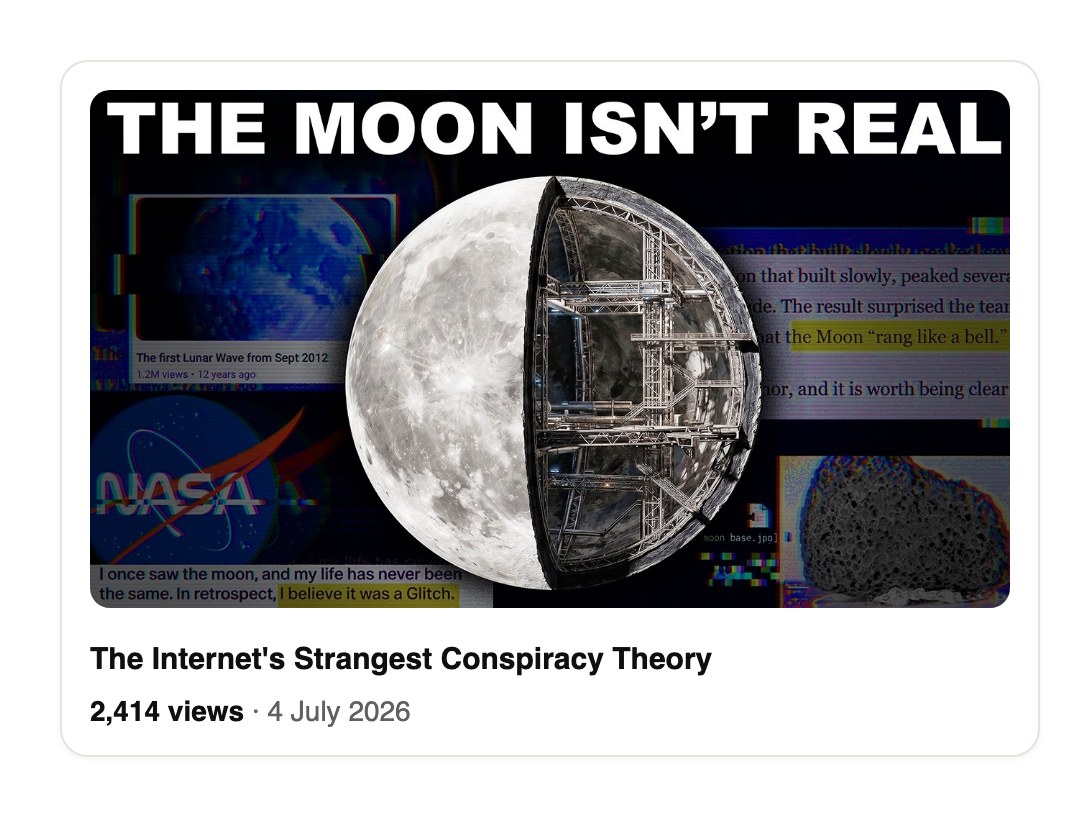
"The Internet's Strangest Conspiracy Theory" packs in eight or more elements: a moon cutaway, a NASA logo, screenshot panels and a highlighted quote band.
In my opinion, that clutter explains the low view count more than anything about its title match.
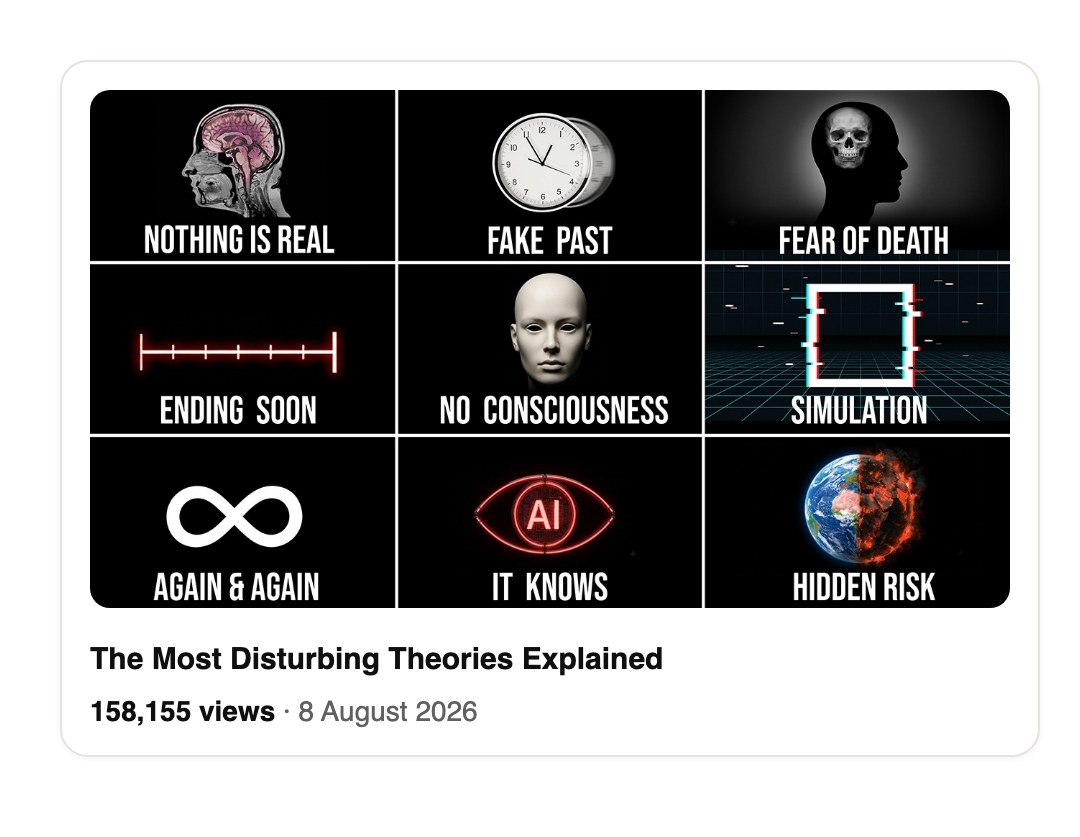
The second-best video uses a 3x3 grid of nine icons and captions. Nobody I could find preaches this style, and every named source argues for fewer elements. It is still the channel's second-best video.
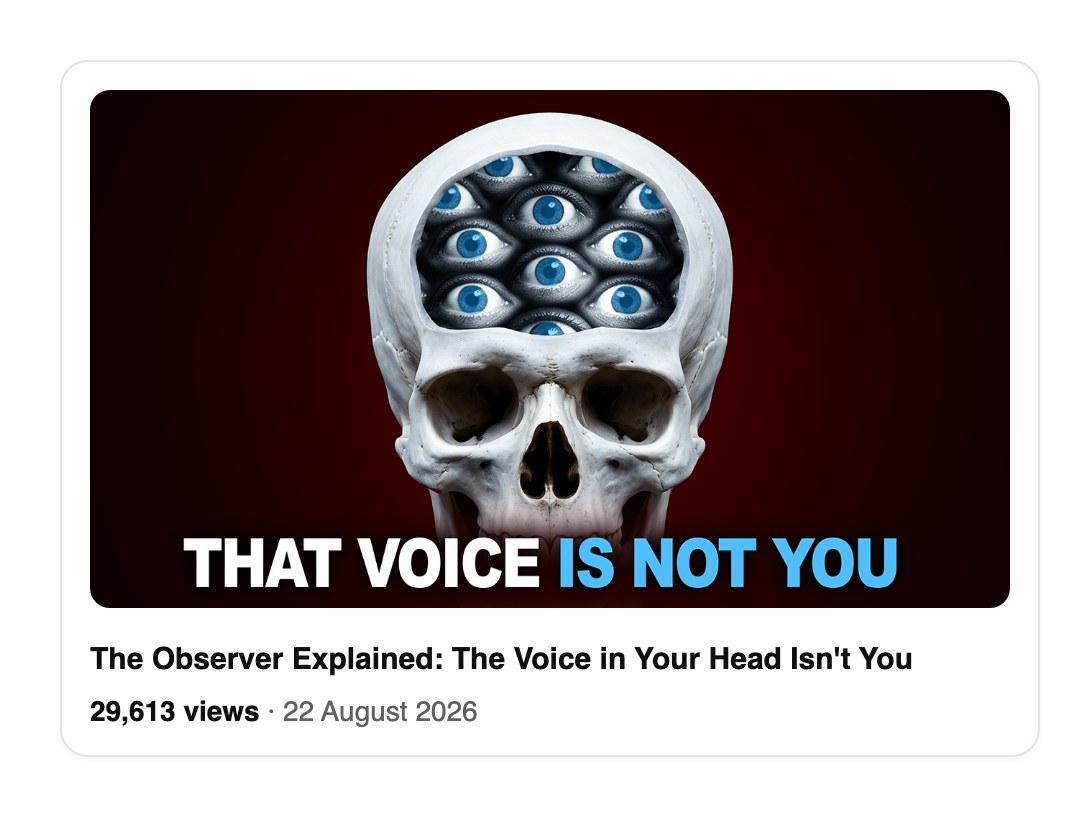
The third video's thumbnail, a skull packed with eyeballs, reads "THAT VOICE IS NOT YOU", which closely repeats its own title's punchline. It sits below both list videos.
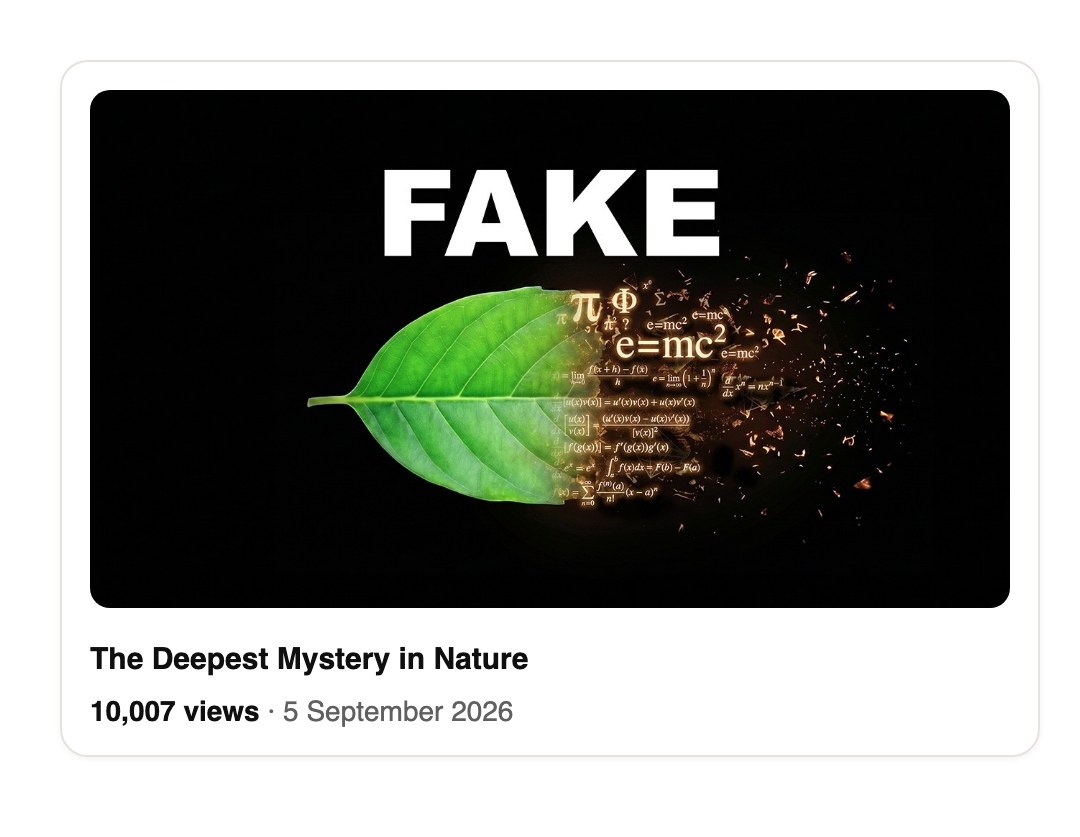
The video right after the outlier uses one word, "FAKE", over a dissolving leaf. It is clean too, but a one-word headline is vaguer, and it only got 10,007 views.
My verdict is that this thumbnail is a close textbook example of Galloway's own rules, and the loop it sets up with the title is the real mechanism behind the click.
But the FAKE thumbnail followed similar rules and did not repeat the result, so clean alone is not enough.
The Title Breakdown
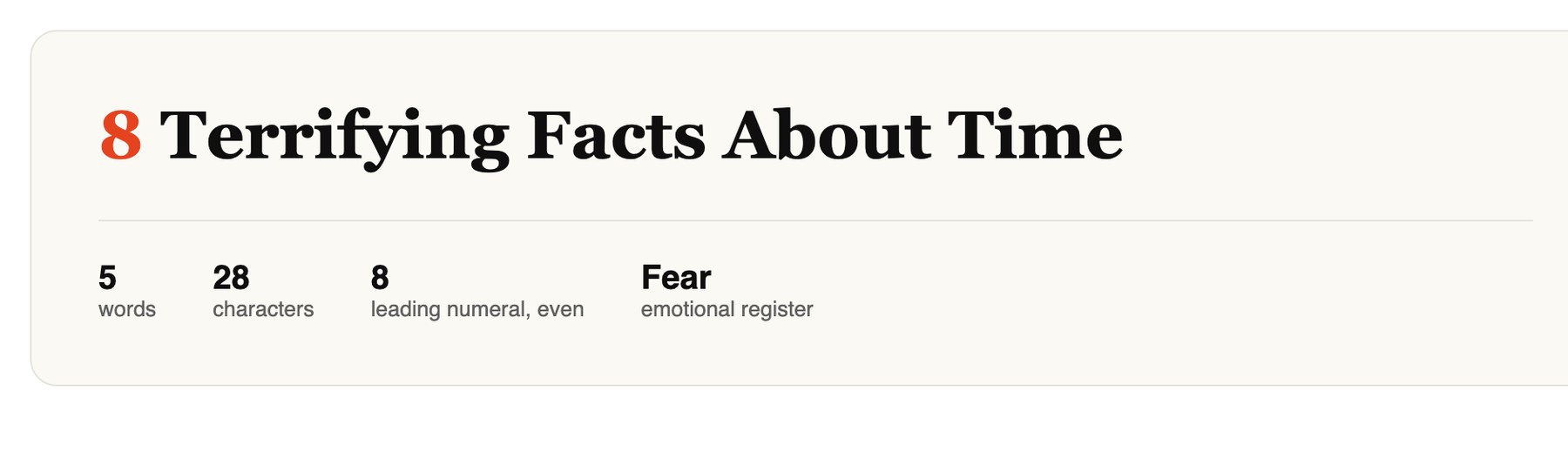
The title is "8 Terrifying Facts About Time". Five words, 28 characters, an even leading numeral, and one fear word.
- 5 words, 28 characters, far under any mobile cutoff.
- Leads with a numeral, 8, which is even.
- One emotional word: "Terrifying".
- No brackets, no channel name, no first-person angle.
Scott Nelson, an SEO consultant, told Databox that odd numbers beat even ones for clicks, in his own testing.
This title breaks that rule. Eight is even, and the video still did 1,551,693 views.
The same channel already tried "Disturbing" (158,155 views) and "Strangest" (2,414 views). Both are fear words too, 65 times apart in results. So the word "Terrifying" by itself cannot explain the jump.
A tool called 1of10 is often credited with the rule that negative words win on YouTube. I could not find 1of10 saying that anywhere.
The real evidence is stronger, and it is academic.
The real source is far better than a tool's marketing page. It comes from Robertson and colleagues, in Nature Human Behaviour, May 2023, studying roughly 105,000 Upworthy headline variations across 370 million impressions.
Quoting them directly: "for a headline of average length (14.965 words), this implies that for each negative word, the CTR increases by 2.3%".
And the opposite direction too: "for each positive word in a headline of average length, the CTR decreases by 1.0%".
Here is the complication, and I do not want to bury it. In that same study, sadness raised clicks. But fear lowered them, against the authors' own hypothesis.
"Terrifying" is a fear word. So by the only rigorous study available, this title used the weakest negative register in the whole study, and it still won.
One limit worth naming. That study measured news headlines on Upworthy, not YouTube titles, so treat the 2.3% as directional evidence from an adjacent medium, not a measured YouTube number.
The stronger explanation, in my opinion, is concreteness rather than negativity. A 2025 Scientific Reports study by two Cornell researchers found that concreteness helps most when a baseline headline was too vague.
The channel's other four titles are all vague phrases starting with "The". This title swaps that for a specific, countable promise: eight facts.
This title also runs against a 1,022-video study by Bill Bergquist at CreatiCalc, which found 12-plus word titles were the only length that won by a significant margin. This one has five words.
Back at the thumbnail, this title is the second half of the loop from section 4. "Eight terrifying facts" reloads the clock-eye image with a countable meaning, and that reload is what I think closes the loop into a click.
vidIQ scores this title 79 out of 100.
The thumbnail scores 17 points higher than the title, 96 against 79.
On a video that won on browse, where the thumbnail is seen first, that gap sits the right way round.
My verdict is that this title breaks two well-known folk rules, odd numbers and shorter length, and uses the weakest fear register in the one real study on negative words.
It still won, because it turned a vague topic into a specific, countable promise.
Is This Format Already Proven?
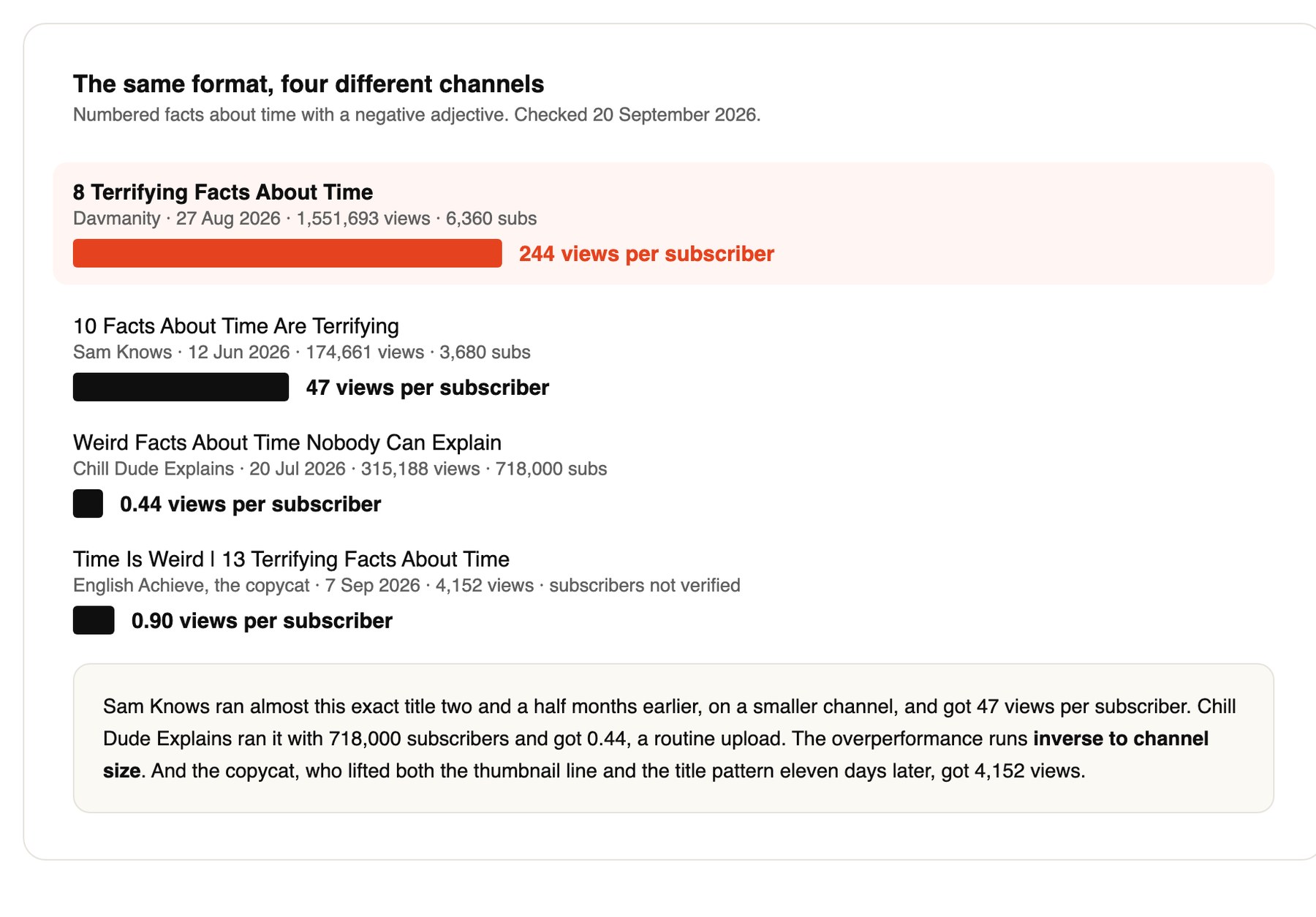
I wanted proof this format works beyond one lucky video, so I checked whether anyone else has run it. All figures below are Breakdown Theory's own YouTube data, checked 20 September 2026.
Sam Knows published "10 Facts About Time Are Terrifying" on 12 June 2026, ten weeks before Davmanity. Its own tag list even contains the phrase "terrifying facts about time".
It did 174,661 views on 3,680 subscribers, which is 47 views per subscriber, a genuine outlier for that channel.
Chill Dude Explains ran the same kind of format on a 718,000-subscriber channel and got 315,188 views. That is 0.44 views per subscriber, a routine upload for a channel that size.
- Sam Knows: 3,680 subscribers, 47 views per subscriber.
- Davmanity: 6,360 subscribers, 244 views per subscriber.
- Chill Dude Explains: 718,000 subscribers, 0.44 views per subscriber.
The overperformance runs inverse to channel size. The smaller the channel, the harder YouTube seems willing to push this exact format to strangers. This is a small-channel format.
Then came the copycat. English Achieve published "Time Is Weird | 13 Terrifying Facts About Time That Will Change How You See Life" on 7 September 2026, eleven days after Davmanity.
It lifted both the thumbnail line and the title pattern. The video runs 43 minutes and 20 seconds, and it had 4,152 views on 14 September 2026.
So packaging is necessary, not sufficient. Copy the thumbnail and title onto the wrong channel and the wrong runtime, and none of the result comes with it.
My verdict is that this format is proven, but only as a small-channel play. It rewarded three channels under 7,000 subscribers and ignored one copycat who got the wrapper right and everything else wrong.
The Intro Breakdown (First 21 Seconds)
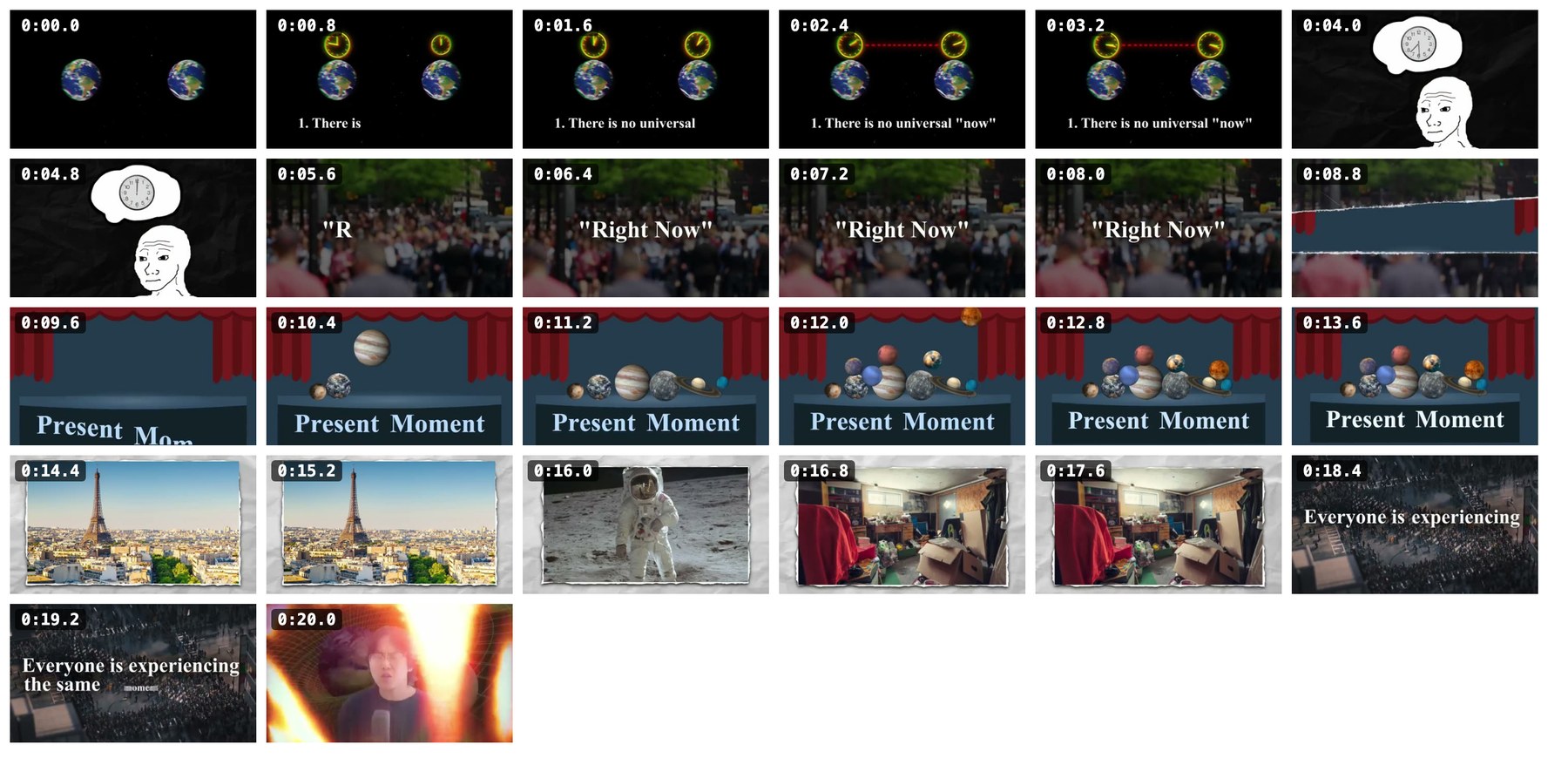
- 19 cuts inside the first 21 seconds, a rate of 54.29 cuts a minute.
- The whole 786-second video averages 19.24 cuts a minute.
- No greeting, no channel branding, no subscribe ask, no self-introduction.
- The creator's face is withheld for the full 21 seconds.
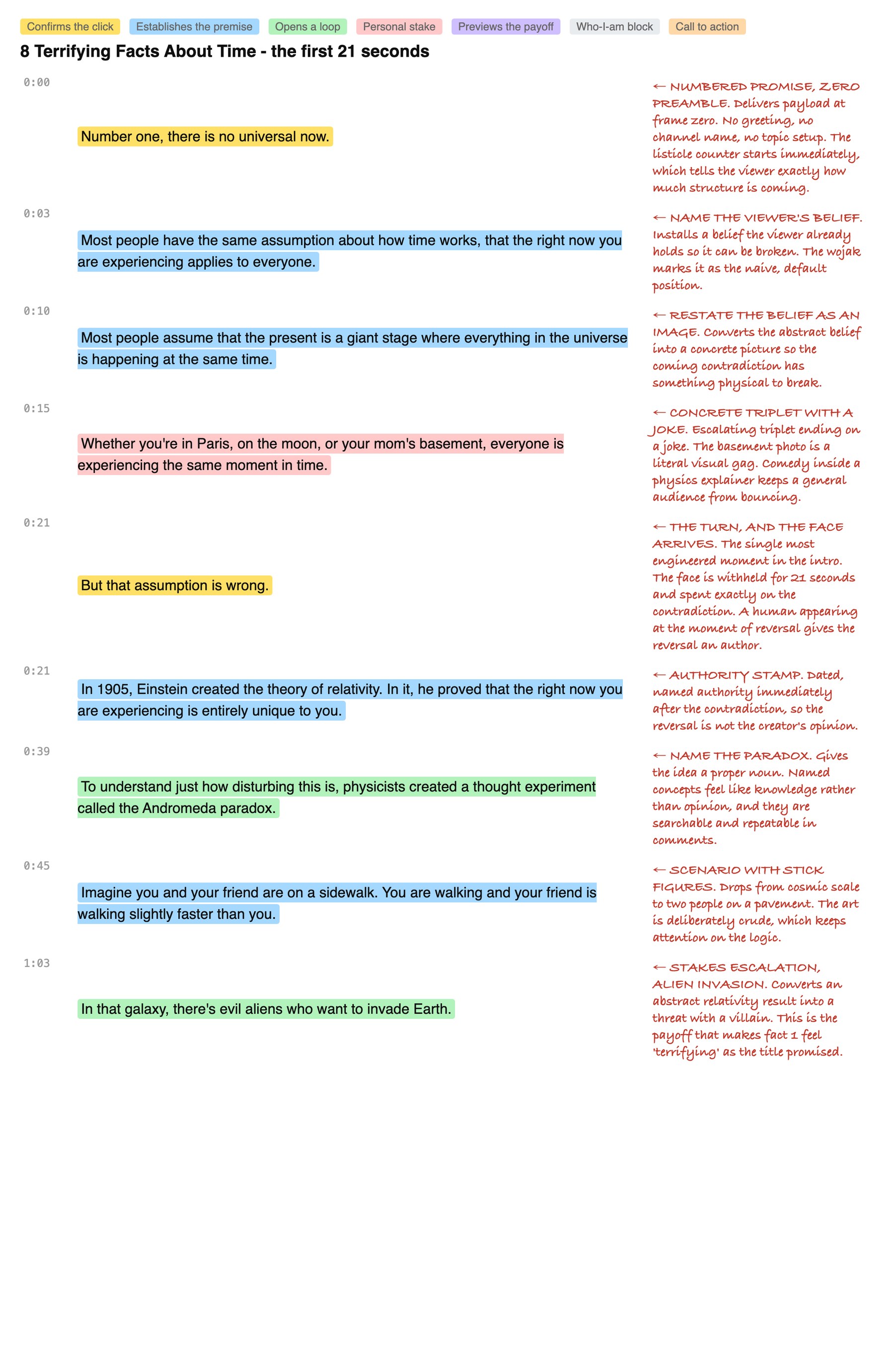
The intro's exact words:
[0:00] "Number one, there is no universal now." [0:03] "Most people have the same assumption about how time works, that the right now you are experiencing applies to everyone." [0:10] "Most people assume that the present is a giant stage where everything in the universe is happening at the same time." [0:15] "Whether you're in Paris, on the moon, or your mom's basement, everyone is experiencing the same moment in time." [0:21] "But that assumption is wrong."
Ali Abdaal's HIVE framework, Hook, Intro, Value, End screen, says a video opens with a Hook before any channel Intro. This video's Hook lands at 0:00.
But the self-introduction letter of HIVE never happens anywhere in the video.
George Blackman, a scriptwriter, calls this move "and this, but that": state the common belief fast, then hit the contradiction.
He writes on his Substack that creators "need to get to the BUT sooner". This video's "but" lands at 0:21.
Paddy Galloway's guide says a good intro should not "make it feel like an intro" at all, per Marketing Examined. This video skips that beat completely.
The most engineered choice, in my opinion, is withholding the face. It first cuts to Davmanity at exactly 0:21, on the word "wrong".
Before that, it is all graphics: a wojak meme, a theatre stage, a photo of Paris, and a messy basement for the joke about "your mom's basement".
Nobody I could find has a named rule about when a creator's face should first appear. So this choice breaks no rule, because as far as I found, none exists either way.
There is one tension worth naming. Minute one carries 30 cuts, the densest minute in the whole video.
An old MrBeast production document says "we lost 21 million viewers in the first minute of the video", per Creator Handbook. That argues for a packed opening.
But MrBeast later reversed that view. In 2024 he wrote that the "ultra fast paced" era of editing "doesn't even work", as reported by Tubefilter. This opening follows his older doctrine, not his newer one.
My verdict is that this intro follows almost every named framework for cutting the fat. Its best move, holding the face back for 21 seconds and spending it on the word "wrong", has no named rule behind it at all.
The Rest of the Video
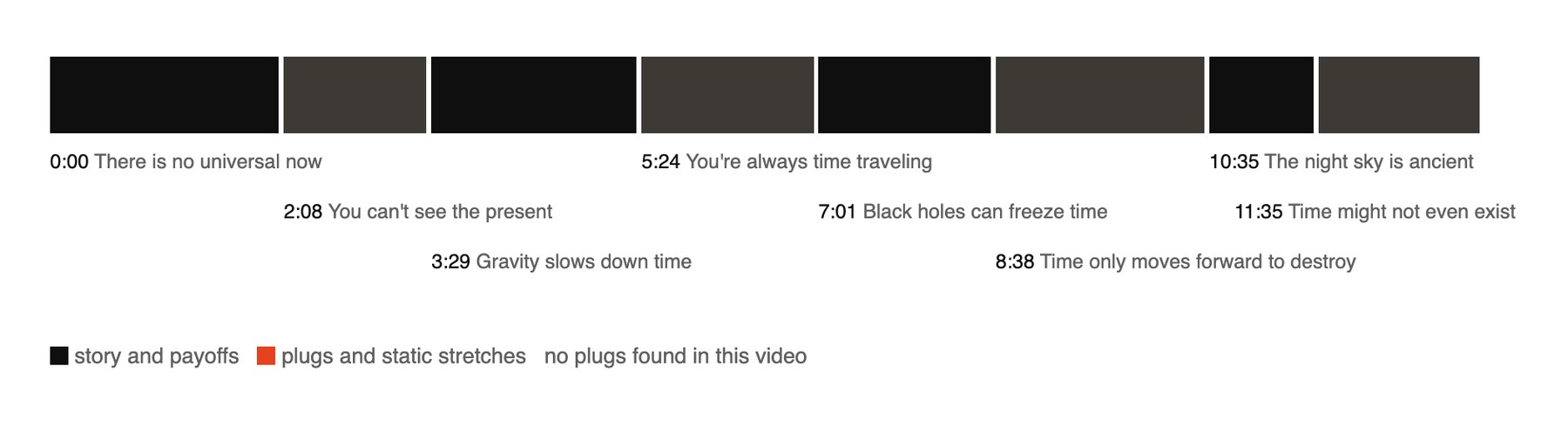
The video numbers eight facts, landing at 0:00, 2:08, 3:29, 5:24, 7:01, 8:38, 10:35 and 11:35. Each segment runs about 98 seconds on average.
- Fact 1, there is no universal now (0:00, 128 seconds)
- Fact 2, you can't see the present (2:08, 81 seconds)
- Fact 3, gravity slows down time (3:29, 115 seconds)
- Fact 4, you're always time travelling (5:24, 97 seconds)
- Fact 5, black holes can freeze time (7:01, 97 seconds)
- Fact 6, time only moves forward to destroy (8:38, 117 seconds)
- Fact 7, the night sky is ancient (10:35, 60 seconds)
- Fact 8, time might not even exist (11:35, 91 seconds)
There are zero plugs anywhere in 786 seconds. No sponsor, no Patreon, no subscribe ask, no comment prompt, and no outro. The video just ends.
The longest stretch without a cut is 19.4 seconds, well under the 45-second mark that usually flags a dead stretch.
Jordan Kruk, who studied over 1,000 high-performing videos, says the best ones "re-open loops or introduce a new unanswered question every 2 to 4 minutes", per his site. This video re-hooks every 98 seconds on average.
But the biggest thing I found here is not about pacing. It is about format.
The channel has run two formats side by side. Two videos number their facts from the first line: this one, and "The Most Disturbing Theories Explained".
- List format: 158,155 and 1,387,707 views.
- Essay format: 2,414, 10,007 and 29,613 views.
The worst list video still beat the best essay video by 5.3 times. There is no overlap between the two groups at all.
Two Cornell researchers, Marianne Aubin Le Quere and J. Nathan Matias, found concreteness helps most when a baseline headline was too vague. That is from their 2025 Scientific Reports paper.
All three essay titles open with the vague word "The".
I have to be honest that the sample here is tiny, just five videos on one channel. One more numbered video that flops would weaken this a lot.
There is also a human story worth naming. Davmanity's own pinned comment, at 2,000 likes, says the idea was borrowed from an AI channel, but he wrote the script and shot the footage himself.
According to the comments, his pinned one reads:
"Fun fact, this video is a remake of an ai slop video. I wrote the script myself, but the video idea was borrowed from an AI video. AI slop is disgusting and I hate it, so I decided to remake the ai video into an authentic human-made video. Please don't watch ai slop, support real creators."
His channel bio says "I hate AI slop". In my opinion, this is the most replicable thing in the whole breakdown: the topic was already proven by an AI channel, and what he added was a real script and a real voice.
The second most liked comment, at 1,400 likes, reads "you've already got 1000 cool points for starting immediately". That is the audience naming the no-intro choice as the thing it liked.
According to the comments, 62.3% are jokes or tangents, not physics debate. A much smaller slice, around 5.3%, pushes back on specific claims, like the Andromeda light-delay point.
Roughly 46 comments raise corrections, nearly all sitting at 0 to 2 likes, the best supported being the Andromeda light-delay objection at 22 likes and a relativity objection to fact 6 at 9 likes.
The contested science is real, but it is a minority voice against a majority that is mostly joking.
My verdict is that this is not a thumbnail win or a title win alone. It is a format win: both numbered-list videos beat all three essay videos, with zero overlap.
The Expected Retention Graph
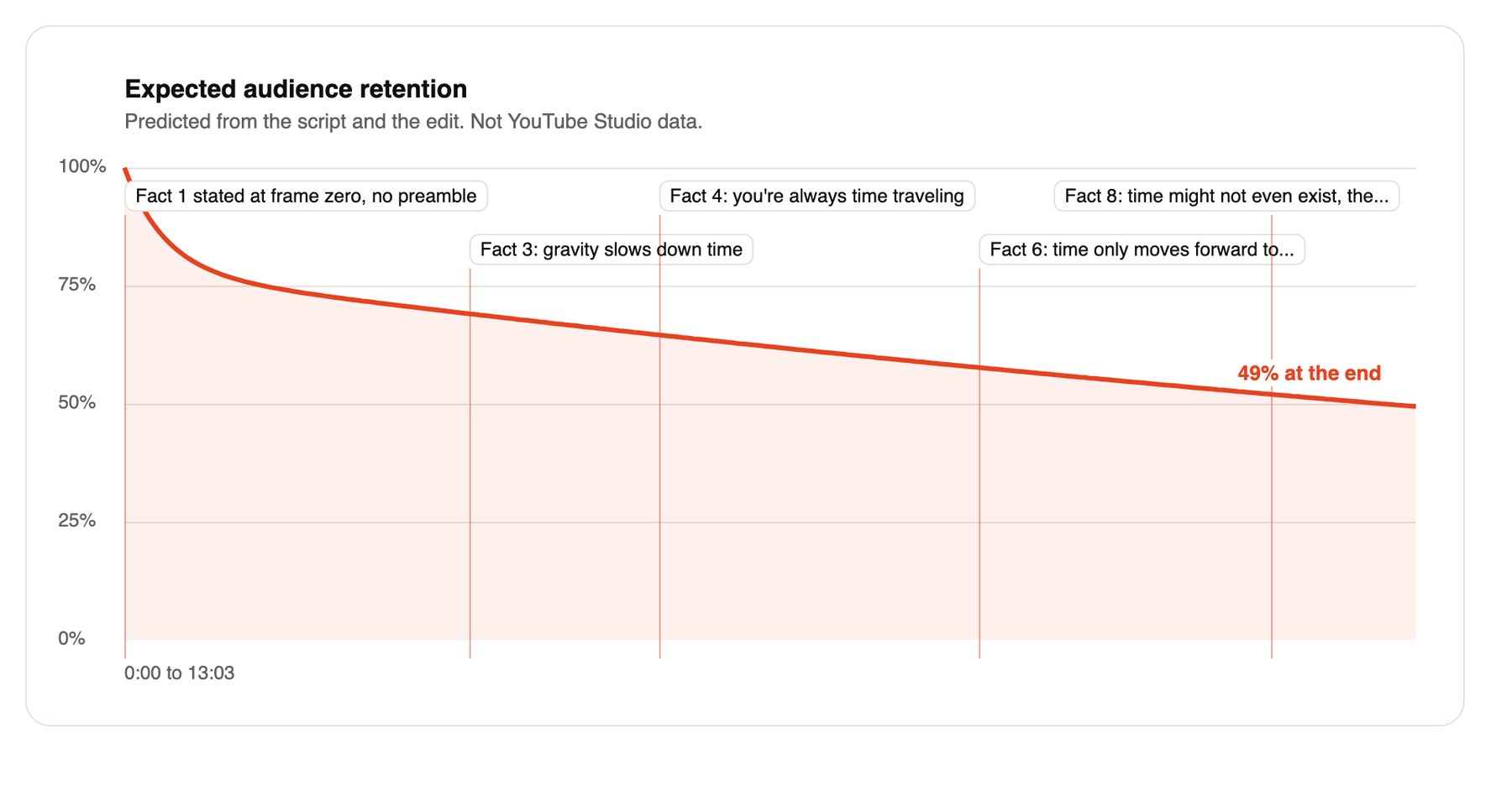
This is a predicted graph built from the script and the edit, not YouTube's real retention data. We do not have Davmanity's actual numbers.
- 0:00, the model starts at 100%.
- 0:21, the face first appears, about 86%.
- 2:09, fact one closes, about 72%.
- 7:00, fact five begins, about 61%.
- 13:06, the video ends, about 49%.
The steepest predicted drop is the first two minutes. This is a normal opening drop nearly every video sees, not something specific this one did wrong.
After that, the curve gets unusually gentle for a 13-minute video. It only falls from about 72% to about 49% across the remaining eleven minutes.
The biggest predicted hold, in my opinion, is that whole back stretch from fact two onward. I think that is because there is no plug, no dead stretch and no subscribe ask anywhere to cause a cliff.
My verdict is that the predicted shape is unusually flat for a video this length. I think that is because nothing in the edit gives a viewer a clean reason to leave early.
But this is a guess built from the edit, not proof of what real viewers did.
I do not think luck explains this. Nobody searches for this title, so search brought almost nobody. That means YouTube showed the thumbnail to strangers on browse and suggested, and the packaging had to earn every single click on its own. On top of that, the same format had already worked for a smaller channel ten weeks earlier, and he has said himself that he took the idea from a video that was already getting views. Almost every variable here was picked, not received.
I would watch what the AI slop channels in my niche are already getting views on, then remake the best idea properly, with a real script and a real voice. The topic is pre-tested for you. The execution is the part they cannot copy, and somebody proved that eleven days later by copying his packaging and getting 4,152 views.
What You Can Take From This
If I were a small creator, I would watch what the AI slop channels in my niche are already getting views on. Davmanity did exactly that, by his own admission, and the topic was pre-tested before he touched it.
Then I would remake the best idea properly, with a real script and a real voice. That is the part an AI slop channel cannot copy, and it is the part no other creator copied from Davmanity either.
- Watch the AI slop channels in your niche for topics already pulling views.
- Remake the best one by hand, with your own script and your own voice.
- Keep the title concrete and countable, not a vague phrase starting with "The".
- Withhold your face for the first block, and spend the reveal on a real contradiction.
I would also run two formats on the same topic type, a numbered list and a free-flowing essay, and see which one actually wins on my own channel.
But I would not copy everything that looked strategic here. Fast cutting in minute one goes against MrBeast's own newer advice, and the 9-panel grid thumbnail breaks every named clutter rule and still did well.
I also would not assume the missing subscribe ask explains the small subscriber count on its own. Nobody I found publishes a real conversion number for that, and I am not going to invent one.
The niche proof in section 6 tells me this works best on small channels specifically. If your channel already has hundreds of thousands of subscribers, do not expect the same multiple.
For the newsletter, I plan to keep tracking this format across the niche and report back what actually happens next.
My prediction is that Davmanity's next numbered-list upload clears the essay median of 10,007 views by a wide margin.
I also predict another small channel somewhere in this niche runs the same format again and clears 100,000 views.
I would call this wrong if a numbered-list upload from him lands near 10,007, or if an essay-format upload clears 158,155.
Judged by 2026-11-20, or 30 days after his next upload, whichever is later.
The Replicable Parts, in One Table
I pulled out the parts I think another creator could actually try. I would still treat every one of these as a hypothesis, not a proven rule.
| What this video did | Who else says it works | How sure we are, and why |
|---|---|---|
| Numbers the payload from line one, on a channel that also tried a vague essay format. | Marianne Aubin Le Quere and J. Nathan Matias, Cornell | High on the pattern. n is 5, one channel. |
| Zero calls to action in 786 seconds. | Todd Beaupre, YouTube's own director of growth | High on the fact. Unproven how much it explains the low subscriber count. |
| Withholds the creator's face for 21 seconds, spent exactly on the word "wrong". | Nobody we found | High on the numbers. No named rule covers face timing either way. |
| Re-opens a new numbered promise every 98 seconds on average. | Jordan Kruk | High. Faster than his published 2-to-4-minute floor. |
| Two elements only in the thumbnail, closing a loop with a title that does not repeat it. | Paddy Galloway | High. The channel's worst thumbnail, 8-plus elements, is the counter-example. |
| A concrete, countable title, 8 facts, instead of a vague topic phrase. | Aubin Le Quere and Matias; Puja Kotecha | High. Matches the channel's own vague titles underperforming. |
| Remade a proven AI slop video idea by hand, with an original script and voice. | Nobody names this directly | High on the fact. This is my own read of the pinned comment. |
| Won on browse and suggested, because the search demand is far too small to produce these views, and the biggest term is the title he created. | vidIQ YouTube keyword data | High. 55,887 a month on his own title still caps search at about 3% of the views. |
| Ran a format already proven on a smaller channel ten weeks earlier. | Sam Knows's own upload | High on the fact. n is three channels across the niche. |
| Used a fear word, the weakest negative register in the one real study on this. | Robertson and colleagues, Nature Human Behaviour | Medium. That study is news headlines, not YouTube titles. |
| Built no brand infrastructure at all, matching the zero-CTA choice inside the video. | Nobody we found | Medium. Cheap art and an empty banner did not stop the video, but n is 1. |
A few things looked promising but probably were not real drivers. The 9-panel grid thumbnail broke every named clutter rule and still did well, so clutter alone is not a clean predictor here.
Ranking number 1 on YouTube for "facts about time" looks impressive, but that keyword only gets 4,059 searches a month, so the ranking itself still moved only a small share of the traffic.
And no named strategist publishes a real number for what a missing subscribe ask costs a channel. That gap stays an open question, not a proven finding.
If this kind of breakdown is useful, the newsletter covers one outlier video like this at a time. That is where I will post the next one.