You have heard "post daily or the algorithm forgets you", and you have heard YouTube say you do not need to. Both cannot be true.
I checked YouTube's own guidance, three large frequency studies, and what small creators report.
Quick answer
- YouTube's Help Centre says growth in views across uploads is not correlated with the time between uploads, so no daily-or-weekly quota exists.
- vidIQ's 10.2 million-channel study (July 2026) found channels posting 12+ videos a month grew views about 4.1x faster than near-dormant ones, a correlation, not a cause.
- OverseerOS tracked 2,565 upload gaps and found breakout odds barely moved: 9.2% under one day vs 11.6% after two-plus weeks.
- AIR Media-Tech's 18,000-channel study found posting above your niche's pace often coincided with fewer subscribers, not more.
- Small channels that had breakout videos posted a median of 1.7 videos a week, the median being the middle value once every channel is lined up in order, and 23.3% of them (44 of 189) posted less than weekly.
Check your own video: paste the link in the free outlier checker. It shows the maths and takes a second.
- YouTube Says The Gap Between Uploads Does Not Change A Video's Odds
- What A 10.2 Million-Channel Study Found About Posting More
- Why Per-Video Studies Find No Bonus For Posting Again Quickly
- Why Posting More Can Backfire On A Small Channel
- What 189 Breakout Channels Actually Posted Each Week
- The Small-Channel Test YouTube Told Creators To Watch
- Conclusion (What I Would Do)
- FAQ: How Often To Post On YouTube
YouTube Says The Gap Between Uploads Does Not Change A Video's Odds
YouTube's own guidance is that upload frequency does not raise or lower any single video's chances, and it has said so in writing for years.
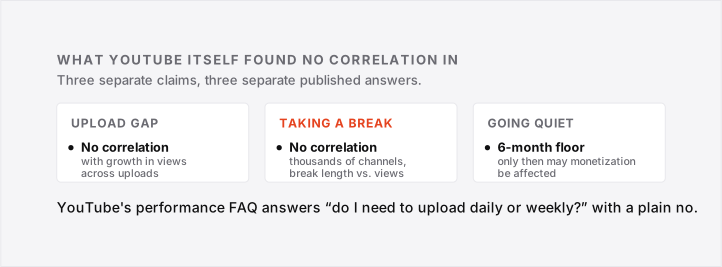
YouTube's performance FAQ answers "Do I need to upload daily or at least once a week?" with a plain no.
It adds that growth in views across uploads is not correlated with the time between uploads, and that many creators build reliable audiences through quality over quantity.
What YouTube Says About Taking Time Off
The same FAQ covers breaks. YouTube studied thousands of channels that took time off and found no correlation between break length and changes in views.
It cautions only that an audience may take time to warm back up, a habit point, not a ranking penalty.
- The FAQ also lists "uploading less frequently than usual" as one possible reason a channel's Home and Suggested traffic dips, a correlation, not a rule.
- A 2021 algorithm explainer video from YouTube adds that no single approach works for all channels.
- The official activity floor is low. Partner Program terms may drop monetization only after 6 months with no uploads or posts.
I think the FAQ's blunt "No" is the single most useful sentence YouTube has published on this topic.
What A 10.2 Million-Channel Study Found About Posting More
vidIQ's July 2026 analysis of 10.2 million channels found that higher-cadence channels grow faster, with a caveat the headlines leave out.
Channels with 1,000 or more subscribers were grouped by uploads per month, Shorts included. Median monthly view growth climbed from 0.53% to 2.18%, a 4.1x gap, in vidIQ's upload-frequency study.
| Uploads a month | Median monthly view growth |
|---|---|
| Under 1 | 0.53% |
| 1 to 3 | 0.89% |
| 4 to 7 | 1.32% |
| 8 to 11 | 1.70% |
| 12+ | 2.18% |
That "4.1x" sounds huge until you look at the absolute numbers, so let me walk the arithmetic once.
These are medians, the middle channel in each group, rather than means, because a handful of huge channels would pull an average upwards.
Take a channel getting 10,000 views a month. At 2.18% growth, that is about 218 more views next month (10,000 x 0.0218). At 0.53%, about 53 more.
The 12+ group grows faster, but this is view growth, not subscriber growth, and 218 extra views is not a breakthrough.
vidIQ's study page states its caveats. The sample starts at 1,000 subscribers and the count mixes Shorts with long-form.
It also shows correlation, not causation, because larger, healthier channels have more resources to publish often.
In my opinion, the safest reading is that busy channels grow faster and grown-up channels can afford to be busy, and the study cannot separate those two.
Why Per-Video Studies Find No Bonus For Posting Again Quickly
If frequency itself powered the algorithm, videos posted soon after the last one would do better. When analysts test that directly, the effect disappears.
OverseerOS, an analytics team, examined 2,565 upload gaps on 59 channels that had already produced breakout videos, meaning videos that took off unusually fast for that channel. Breakout odds by gap:
| Gap before upload | Breakout rate |
|---|---|
| Under 1 day | 9.2% |
| 1 to 2 days | 11.6% |
| 2 to 4 days | 11.4% |
| 4 to 7 days | 10.3% |
| 7 to 14 days | 10.5% |
| 14+ days | 11.6% |
The rates hover between 9.2% and 11.6% with no pattern, which is the point: a video's odds did not rise because it followed a recent upload quickly.
- The study ran a chi-square test, a standard check for whether differences between groups are real or just noise, and got p = 0.727, far above the usual 0.05 bar for calling a difference real.
- The long-form-only slice tilted the other way: videos after an under-one-day gap broke out 5.6% of the time vs 12.4% after 7 to 14 days.
So the cleanest reconciliation of everything above is: more uploads can mean more total attempts, but posting yesterday did not make today's video more likely to pop.
Why Posting More Can Backfire On A Small Channel
The clearest sign that more can mean worse compares a channel's busy months against its slower ones.
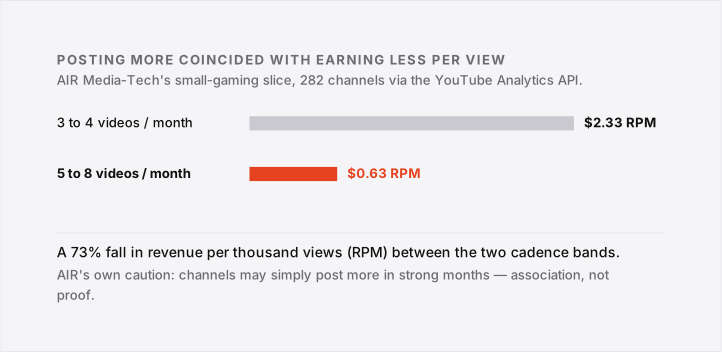
AIR Media-Tech studied 282 channels through the YouTube Analytics API.
Its small-gaming slice is the sharpest fall: revenue per thousand views dropped from $2.33 at 3 to 4 videos a month to $0.63 at 5 to 8, a 73% fall.
AIR's own caution: channels may simply post more in strong months, so this is association, not proof.
- AIR's larger 18,000-channel study found most niches had a pace peak, and channels above it had fewer median subscribers, with Health & Fitness peaking at 2 to 5 videos a month.
Why A Fixed Audience Explains The Drop
I think the mechanism is ordinary attention: a small audience has a fixed budget of watching time, so each extra video earns less.
What 189 Breakout Channels Actually Posted Each Week
Cadence tables of winners get misread as instructions, so it helps to see the real spread before copying anyone's calendar.
OverseerOS analysed 189 channels that each produced at least one video hitting 5x that channel's recent view velocity within 90 days back from mid-August 2026. Their cadence:
| Channel size | Median uploads per week |
|---|---|
| Under 10K subs | 1.7 |
| 10K to 99.9K | 2.6 |
| 100K to 999.9K | 2.6 |
| 1M+ | 3.9 |
- The overall median was about 2.7 videos a week, but the range ran from 1 to 86 uploads in 90 days, an 80-fold spread.
- 44 of the 189, about 23%, published less than roughly once a week and still had a qualifying breakout.
- 9 channels managed a breakout on just 1 to 3 videos in 90 days.
I read this as: there is no floor under weekly.
But these channels already broke out, so nobody has shown that low-cadence channels who never broke out did not simply post too little.
The Small-Channel Test YouTube Told Creators To Watch
There is one official diagnostic for overposting, and it is not a calendar. It is a number YouTube asked creators to watch: average views per viewer.
The 2021 algorithm video defines it: if you upload more and average views per viewer falls, you are releasing more videos than your audience will watch, because your viewers are splitting their attention across more videos.
Average views per viewer is one division: total views in a period, divided by the number of separate people who watched in that period.
The Arithmetic, With Round Numbers
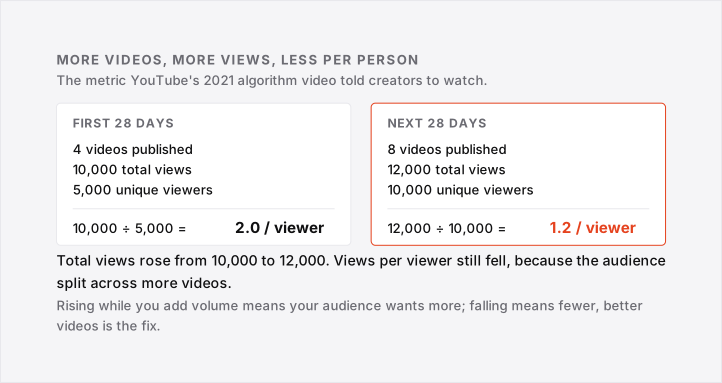
Over 28 days you publish 4 videos. They collect 10,000 views from 5,000 unique viewers, so 2.0 views per viewer.
Next 28 days you publish 8 videos instead. Total views rise to 12,000, which looks like progress. But those views came from 10,000 unique viewers. Now it is 12,000 divided by 10,000, so 1.2 views per viewer.
More uploads, more total views, and yet each person is watching less of you than before. That is the shape the metric is built to expose, and it is invisible if you only watch the view count.
How To Read It In YouTube Studio
- In YouTube Studio, it sits under the Audience tab as "Average views per viewer".
- To check one upload against your own median, use the outlier checker.
- Rising while you add volume means your audience wants more.
- Falling means you overshot, and the honest fix is fewer, better videos.
What One Small Creator Reported After Going Daily
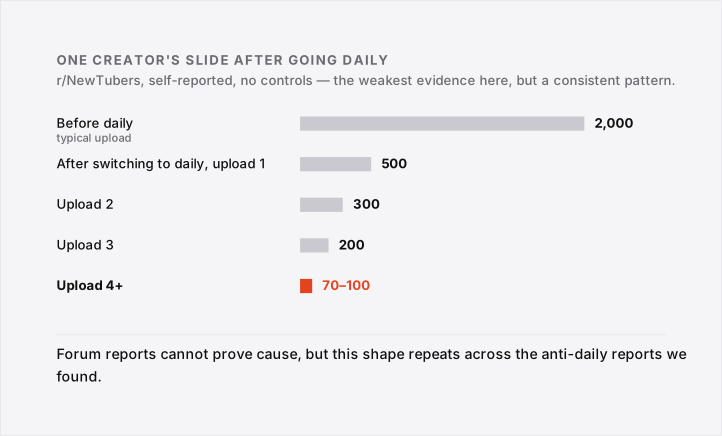
Forum reports are weak evidence, self-reported with no controls, but this one fits the metric above.
A r/NewTubers creator had videos near 2,000 views, went daily, and saw a typical upload slide from 500 to 300 to 200 to 70-100.
Conclusion (What I Would Do)
Hold one cadence for 8 to 12 weeks, one you can keep without the videos getting worse, and watch average views per viewer in YouTube Studio.
Change it only if that number falls as you add uploads. To judge a cadence change against your own median, score your uploads in the channel analyzer.
For evidence-led weekly video breakdowns, you can join the newsletter.
FAQ: How Often To Post On YouTube
How often should a new YouTube channel post?
Once a week is the safe starting cadence, and the evidence for anything higher is weak.
YouTube says the gap between uploads does not change a video's odds. Pick a rate you can hold for three months.
Is posting daily on YouTube better than weekly?
There is no study showing daily beats weekly on a per-video basis. Daily raises your total shots on goal, but only if quality holds. The creator reports in this piece describe the opposite outcome more often than not.
Does posting more often hurt your channel?
It can, indirectly. Nothing penalises frequency itself, but splitting the same audience across more videos lowers average views per viewer, and thinner work earns fewer clicks. Watch the metric, not the calendar.
How long should you keep a posting schedule before judging it?
Give it at least 8 to 12 weeks, or roughly 10 uploads, whichever is longer.
A single video swings far too much to read a cadence from it, which is the same reason an outlier score is measured against a run of uploads rather than one.
Does the YouTube algorithm reward consistency?
Not directly. Consistency builds a habit for viewers and gives you enough uploads to see a pattern.
If views are flat regardless of cadence, the problem is usually packaging or retention (how much of a video people watch), covered in why videos stall.