You want a channel without showing your face, and every page saying yes is selling a tool or a course. So is the format itself worth it?
I read YouTube's live policy on 30 September 2026, pulled views for five big faceless channels that day, and used our own unpublished outlier study.
You will leave knowing whether it suits you and which risk to plan around.
Quick answer
- Faceless is allowed. YouTube's policy never asks for a face, and since 15 July 2025 its "inauthentic content" rule bars mass-produced and AI-template videos instead (policy).
- The crackdown hit template farms: TNW reported YouTube terminated 16 AI-slop channels with 35 million subscribers and 4.7 billion lifetime views in January 2026, naming no source; YouTube did not confirm it (TNW).
- I found no YouTube "video 20" milestone. In our own outlier study (not yet published), the next five uploads after 53.4% of 1,122 breakout videos had a median (middle value) under 1.5 times the channel's previous 20, against 80.5% after ordinary videos.
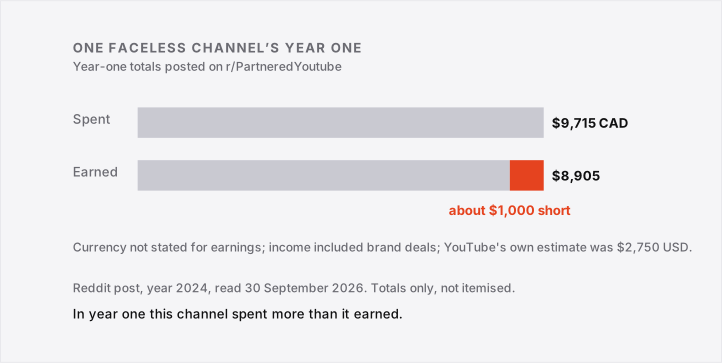
- Money is slow. One creator's year-one totals show $9,715 CAD spent and $8,905 earned (currency not stated), about $1,000 short (Reddit post).
- From 1 February 2027, new Partner Program applicants need 8,000 watch hours in 365 days or 20 million Shorts views in 90 days, plus 1,000 subscribers (YouTube Help).
Check your own video: paste the link in the free outlier checker. It shows the maths and takes a second.
- YouTube's Faceless Channel Rules: What Is Allowed and What Changed Since 2025
- What Happens After Video 20 on a Faceless YouTube Channel
- Why Big Faceless Channels Cannot Show You Your Odds
- Faceless YouTube Is Not a Scam, but Its Course Sellers Follow a Pattern
- What a Faceless YouTube Channel Earns in Its First Year
- What Viewers on Reddit Say About Faceless and AI-Voice Channels
- Who a Faceless YouTube Channel Suits and Who It Does Not
- Conclusion (What I Would Do)
- FAQ: Faceless YouTube Channels
YouTube's Faceless Channel Rules: What Is Allowed and What Changed Since 2025
Faceless channels are allowed. YouTube's monetisation policy bars mass-produced or repetitive content and names no face requirement. Since 15 July 2025 it calls that "inauthentic content", a minor update.
The Inauthentic Content Rule Targets Templates, Not Faces
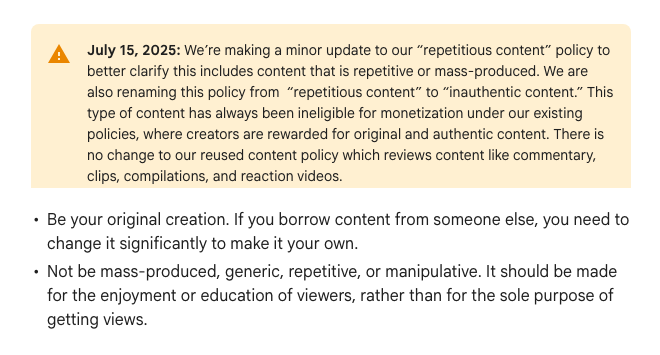
- YouTube renamed "repetitious content" to "inauthentic content" on 15 July 2025, covering mass-produced and repetitive videos.
- AI-generated template content is one of the policy's own examples of what is not allowed.
The 2025 to 2026 AI-Slop Crackdown Hit Template Farms
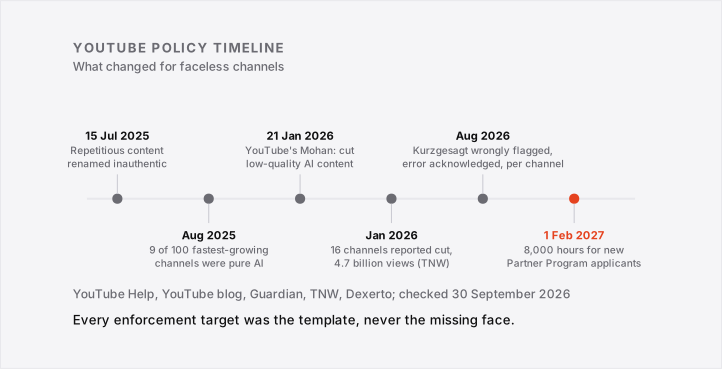
- The Guardian reported that 9 of the 100 fastest-growing channels in July 2025 were purely AI; YouTube said it removed 3 of those flagged and blocked ads on 2 more.
- TNW reported that YouTube terminated 16 channels with 35 million subscribers in January 2026; it names no source.
- Kurzgesagt was wrongly flagged in August 2026, and the channel said YouTube staff acknowledged the error.
TNW notes YouTube is careful to say it is not banning AI, and a spokesperson told the Guardian generative AI "is a tool". I think the risk is looking templated, not being faceless.
The February 2027 Partner Program Threshold for New Channels
The Partner Program (YPP) is YouTube's ad-revenue programme. It asks today for 1,000 subscribers plus 4,000 watch hours (hours viewers spent on your videos) in 12 months, or 10 million Shorts views in 90 days.
From 1 February 2027, new applicants need 8,000 hours in 365 days or 20 million Shorts views in 90 days. Existing members are unaffected.
What Happens After Video 20 on a Faceless YouTube Channel
I found no YouTube-published video-count milestone, so "video 20" is a creator habit, not a rule. What exists are all-format base rates and a common pattern: one lucky video, then a stall.
No Published Video-Count Gate, Only Base Rates
- Pex found 88.4% of all public videos had under 1,000 views at the end of 2019.
- vidIQ's 2026 data says 40.6% of 61.2M channels with at least one subscriber had reached 1,000, so 59.4% had not.
- faceless.my says over 90% never reach 1,000, with no source.
None of these is faceless-specific.
The One-Viral-Video Stall Creators Describe
- One creator joined the Partner Program at about 15 videos thanks to a single viral video, then saw views slow and uploads drop.
- Another posted a first video near 400k views, then about 10 more averaging around 500.
What Our Outlier Study Shows After a Breakout
An outlier is a video far above its channel's normal, meaning the median (middle) view count of recent uploads.
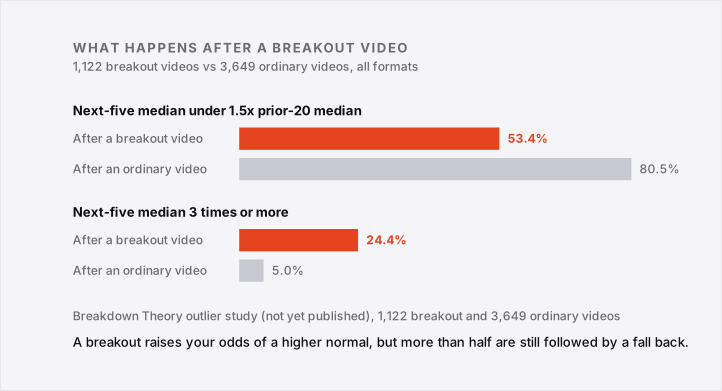
In our own outlier study (not yet published), the median of the next five uploads was under 1.5 times the channel's previous-20 median after 53.4% of 1,122 breakout videos, against 80.5% of 3,649 ordinary videos.
And 24.4% reached 3 times or more, against 5.0%. These are all formats, not faceless-only.
Why Big Faceless Channels Cannot Show You Your Odds
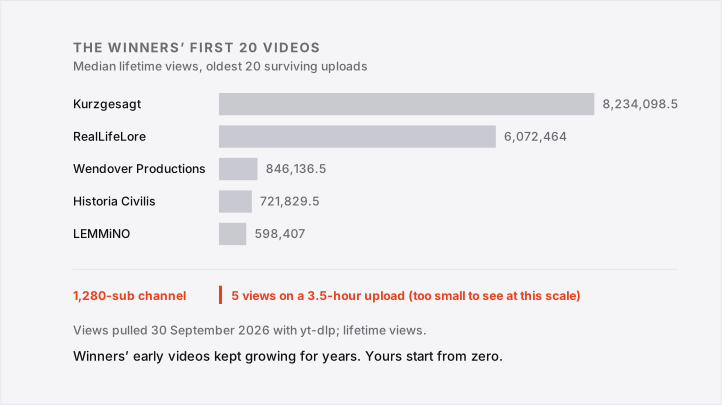
The first 20 surviving uploads of five big faceless channels have medians of 598,407 to 8,234,098.5 views, pulled 30 September 2026. Those are lifetime views from winners I picked, so they say little about your video 20.
- Kurzgesagt: 8,234,098.5 views
- RealLifeLore: 6,072,464 views
- Wendover Productions: 846,136.5 views
- Historia Civilis: 721,829.5 views
- LEMMiNO: 598,407 views
Two Biases Hide the Channels That Stalled
- Lifetime views keep growing: RealLifeLore's 15th upload, from 2016, had 50,475,694 views on a 7,940,000-subscriber channel on 30 September 2026.
- Survivorship bias: channels that stalled at video 20 are not in my sample, and deleted early uploads are invisible.
- For contrast, a channel with 1,280 subscribers put up a 3.5-hour video on 22 August 2026; it had 5 views on 30 September 2026.
So my data has limits: winners only, lifetime views, nothing about your channel. I send a weekly breakdown of one channel's outlier video.
Faceless YouTube Is Not a Scam, but Its Course Sellers Follow a Pattern
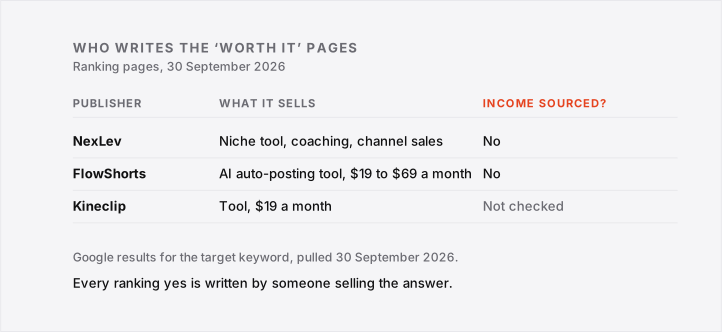
Faceless YouTube is a legitimate format, and the scam risk sits with the people selling it. The ranking pages I checked on 30 September 2026 the ones I checked were written by vendors of tools or coaching.
Who Publishes the Worth It Pages
- NexLev sells a niche tool, coaching and a channel-selling platform, and calls $5,000 to $10,000 a month realistic with no source.
- FlowShorts sells an AI auto-posting tool on $19 to $69 monthly plans, and gives RPM (earnings per 1,000 views) ranges without citations. Our money calculator uses cited 2026 medians instead.
The Pattern Creators Report
- A promise of $30K-plus a month within a set number of days, attached to a class priced at $5,800.
- One creator wrote that every method they tried came from someone selling a course about that method.
- The Guardian reported in December 2025 that in the AI-slop ecosystem, course sellers often make more money.
A r/NewTubers thread, "The Faceless YouTube Agency Model Feels Exploitative", argues agencies underpay editors; the complaint is about the middleman model, not the format.
Before paying anyone, I would ask three things. Is the income figure sourced, does the page mention the inauthentic content policy, and does the seller earn mainly from the course? No, no and yes means keep your money.
What a Faceless YouTube Channel Earns in Its First Year
One creator's year-one totals show $9,715 CAD spent and $8,905 earned, currency not stated (Reddit post). YouTube pays 55% of long-form ad revenue and guarantees no earnings.
Self-Reported Outcomes, Not a Representative Sample
- The same creator says income included brand deals, YouTube's own estimate was $2,750 USD, and ad revenue is not enough under 10k views a video.
- Two monetised faceless channels earn about $80 and $500 a month.
- One creator's best video took six months to reach 100k views and now earns about $40 a month.
- One commenter knows someone who saw consistent returns only after about 70 videos, then a few hundred dollars a month.
What Viewers on Reddit Say About Faceless and AI-Voice Channels
Viewers on Reddit separate faceless from automated: one commenter says they leave at an AI voice, another says faceless is fine but automated cash-cow channels are not.
- A commenter on r/PartneredYoutube writes, "Faceless is not a niche, it is a style of video that can be used in any niche."
- A faceless creator warns that viewers cannot connect to a face, so the editing and visuals, not just the audio, have to be top quality.
- Two viewers, quoted below, say they leave the moment they hear an AI voice.
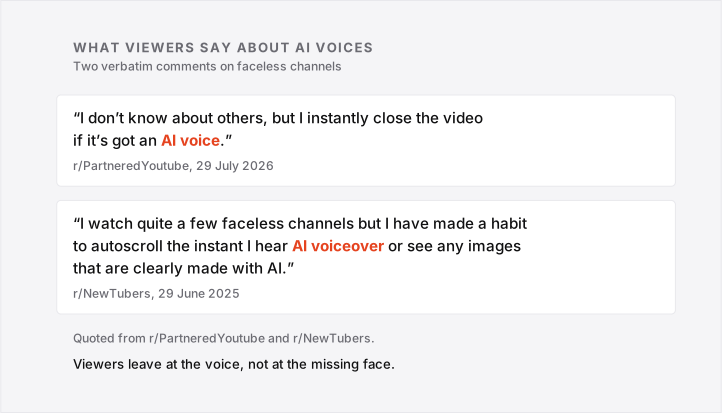
Comments show how some viewers feel, not how many.
A Human Remake Beat the AI Template It Copied
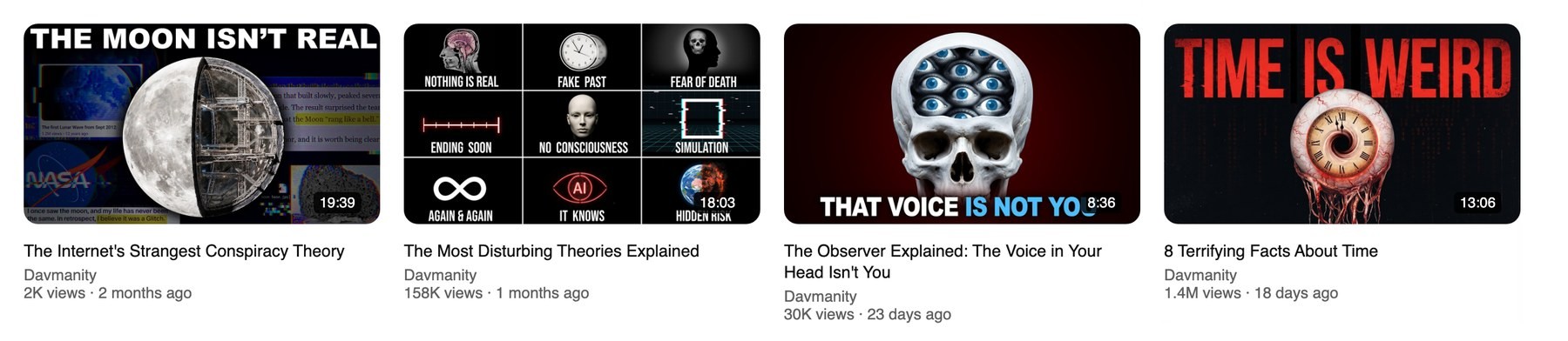
In our own YouTube outlier breakdown on Davmanity, "8 Terrifying Facts About Time" is a human remake of an AI-slop video.
It had 1,387,707 views on 14 September 2026 (1.79 million by 30 September) against a median of 19,810 across four other uploads.
That channel is not faceless, since the creator's face first appears at 0:21. So it is evidence that a real script and voice can beat the template, not proof for the format.
Who a Faceless YouTube Channel Suits and Who It Does Not
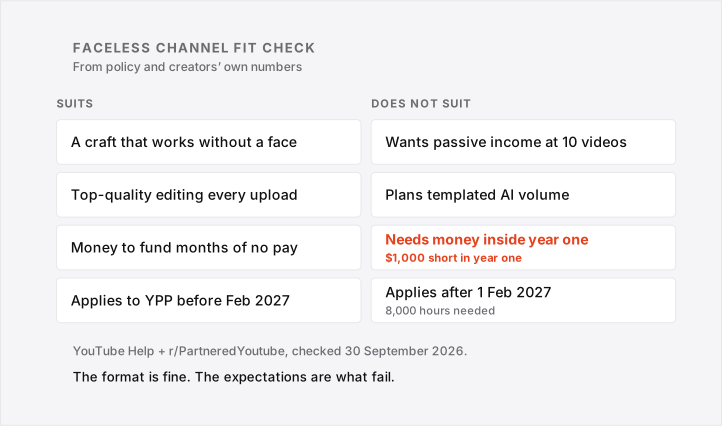
A faceless channel suits someone with a skill that works without a face and patience for months of unpaid labour. It does not suit anyone buying passive income or planning templated AI volume, which the policy excludes.
It Suits You If
- You have a craft that works without a face, such as animation, maps, gaming or research. One faceless gaming creator reports nearly 20k subscribers and 200k views a month.
- You can hold top-quality editing across dozens of uploads.
- You can fund months of unpaid work.
It Does Not Suit You If
- You want passive income after ten uploads; one creator calls that the trap.
- Your plan is cheap, low-quality volume, which one creator says faceless gurus taught last year and YouTube is now demonetising.
- You need the channel to pay inside year one, when one creator's totals ended $1,000 short.
- You would apply to the Partner Program after 1 February 2027, when the bar rises to 8,000 watch hours.
Conclusion (What I Would Do)
My answer: a faceless channel is worth it as a format if you are making it, not buying it.
- Research one niche first, using the free outlier method.
- Write and voice video 1 yourself, since an AI voice is where viewers say they leave.
- Judge each upload against your own normal, not the winners'. If one lags, test its thumbnail and title.
- Apply to the Partner Program before 1 February 2027 if you can, while the 4,000 hour bar still applies.
FAQ: Faceless YouTube Channels
Does YouTube pay $3 for 1,000 views?
No fixed rate exists. YouTube shares 55% of long-form ad revenue and guarantees no earnings. Per-view ranges on ranking pages, like FlowShorts, cite no sources.
How long does it take to get monetised on YouTube?
No official timeline exists. The bar is 1,000 subscribers and 4,000 hours in 12 months, or 10 million Shorts views in 90 days.
Can 500 subscribers make money on YouTube?
Yes, through the lower fan-funding tier: 500 subscribers and 3,000 hours or 3 million Shorts views. Fan funding pays creators a 70% share.
Who is the biggest faceless YouTuber?
No official ranking exists. Of the channels I pulled, Kurzgesagt is the largest, at 25,600,000 subscribers on 30 September 2026.
It said in 2023 that 65% of its 2020 to 2022 income came from viewers (merchandise, Patreon and AdSense).
Can you make a living from a faceless YouTube channel?
Some creators say so, none with audited numbers. One says six faceless channels average about 3k a month; another knows someone who needed about 70 videos for a few hundred dollars. Treat both as anecdotes.