You already upload, and wonder whether to pay a team to make your videos. Most pages ranking for this sell a tool, course or service.
I read YouTube's Partner Program pages on 13 November 2026, vendor prices, Reddit owner posts (self-reported) and our outlier study. I could not verify freelancer rates.
By the end you can run the break-even sum on your channel and tell a business from a job you bought.
Quick answer
- "YouTube automation" means paying freelancers, not software: the New York Times called the name "a bit of a misnomer". One outsourced video costs $100-$500 per vidIQ, and $500-$2,000+ at bigger channels per one operator.
- At a realistic RPM (earnings per 1,000 views after YouTube's cut) of $1.50-$3 for most niches, a $150 video needs 50,000-100,000 views just to pay for itself.
- One owner paid $395 a video at a $6 RPM, so needed about 65,833 views each. His videos got about 500, which earns $3 per video.
- The owner still works: 1of10 says owners rewrite 40-60% of scripts, and one owner reports at least 4 hours a day.
- From 1 February 2027, new Partner Program applicants need 8,000 watch hours in 365 days, double today's 4,000, or 20 million Shorts views in 90 days.
Check your own video: paste the link in the free outlier checker. It shows the maths and takes a second.
- YouTube Automation Is Outsourcing, and the Scam Risk Sits in the Packages
- The Real Cost Stack Behind One Outsourced YouTube Video
- The Management Hours an Automated YouTube Channel Still Needs
- YouTube Automation Margins at a Realistic RPM
- YouTube's 2026 Rule Changes That Raise the Cost of Automation
- When YouTube Automation Is a Business and When You Have Bought Yourself a Job
- Conclusion (What I Would Do)
- FAQ: YouTube Automation
YouTube Automation Is Outsourcing, and the Scam Risk Sits in the Packages
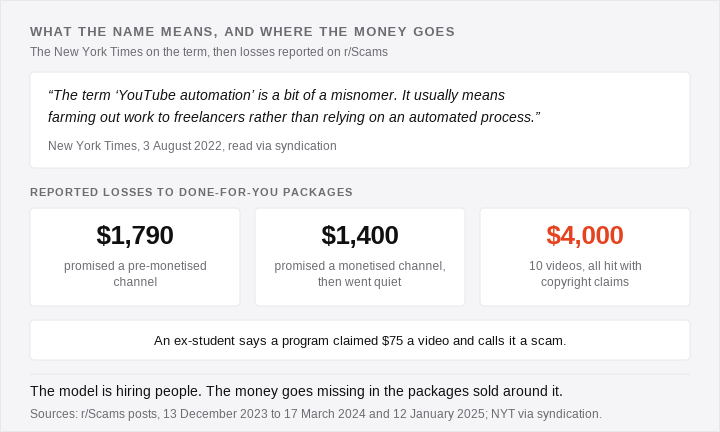
YouTube automation is a business model where you pay freelancers to write, voice and edit videos while you manage them. The New York Times called the name a bit of a misnomer because it rarely means software doing the work.
The model itself is allowed. YouTube's monetisation policy bars templated mass production and AI personas posing as human experts, and I found nothing against hired help. The faceless format post has the detail.
Where People Lose Money Is the Package
Reported losses cluster around done-for-you packages, where someone sells you a ready-made channel.
- $1,790 for a program that promised a pre-monetised channel (r/Scams post).
- $1,400 for a course that promised a monetised channel, then the seller went quiet (r/Scams post).
- $4,000 for a program whose 10 videos all drew copyright claims (r/Scams post).
- An ex-student says a program claimed $75 a video and calls it a scam (r/Scams post).
One buyer the NYT profiled spent $20,000 on an automation program and said the upfront cost makes it not worth it. A promoter in the piece earned 70% of his income from his own $995 course.
The Real Cost Stack Behind One Outsourced YouTube Video
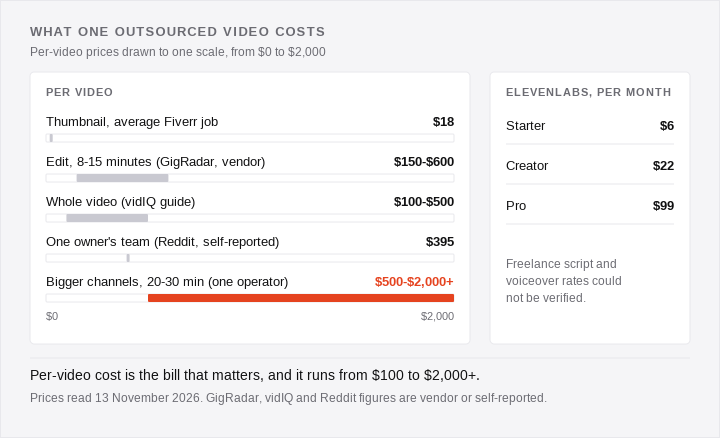
One outsourced YouTube video costs about $100-$500, according to vidIQ's guide. One operator says bigger channels pay $500-$2,000+ for a 20-30 minute video, including a channel manager.
What Each Role Costs
| Role | Price | Source |
|---|---|---|
| Thumbnail | About $18 per job, unconfirmed | Fiverr hire page |
| Edit, 8-15 minutes | $150-$600 per video | GigRadar, vendor blog |
| Voice tool | $6, $22 or $99 a month | ElevenLabs pricing |
| Script and voice freelancers | Not verified | I could not verify a live rate |
What a Whole Month Costs
- One documentary-niche owner's team cost $395 a video, self-reported.
- vidIQ's $100-$500 per video, at 8 videos a month, is 8 × 100 = $800 up to 8 × 500 = $4,000. At 4 videos: $400-$2,000.
- 1of10, a vendor, puts a fully outsourced channel at $500-$2,000 a month, unsourced.
I would price each role for one of your videos, then multiply by your monthly uploads.
The Management Hours an Automated YouTube Channel Still Needs
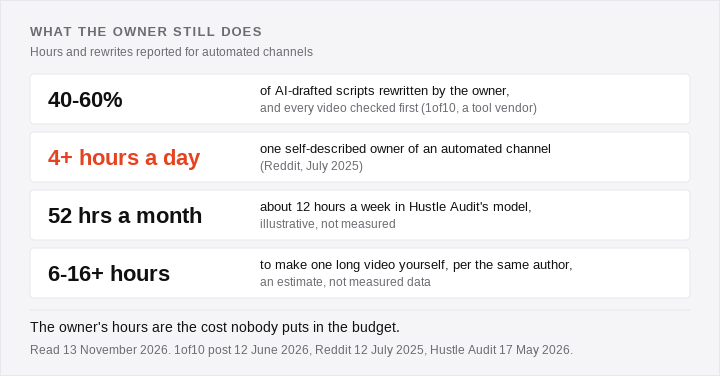
Management time is the cost nobody prices. 1of10, which sells a tool to automation channels, says the owner rewrites 40-60% of AI-drafted scripts and checks every video before it goes live.
What the Owner Still Does
- Subscribr, a vendor, says the owner still manages freelancers and quality control.
- One owner says you still manage a team unless you pay a channel manager.
- One self-described owner spends at least 4 hours a day on it.
- An ex-student of a program says it was sold as passive income but meant hiring, managing and analysing.
Hustle Audit models 52 owner hours a month, about 12 a week, and estimates 6-16+ hours to make one long video yourself. Both are the author's estimates, not measured data.
I think the honest test is to time one week of your own script edits and sign-offs.
YouTube Automation Margins at a Realistic RPM
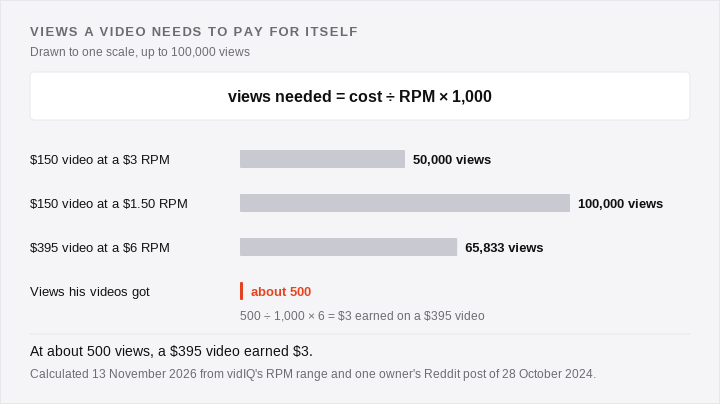
At the $1.50-$3 RPM that vidIQ reports for most niches, a $150 outsourced video needs 50,000-100,000 views just to pay for itself. RPM is revenue per 1,000 views, counted after YouTube's share is already taken out.
The Break-Even Sum, Worked Once
Break-even views are the views a video needs before its ad earnings cover its cost. The sum is cost ÷ RPM × 1,000.
- A $150 video at a $3 RPM: 150 ÷ 3 × 1,000 = 50,000 views.
- A $150 video at a $1.50 RPM: 150 ÷ 1.5 × 1,000 = 100,000 views.
- One owner paid $395 a video at a $6 RPM: 395 ÷ 6 × 1,000 = 65,833 views needed (Reddit post).
- His videos got about 500 views, which earns 500 ÷ 1,000 × 6 = $3 against $395 spent.
AdaptlyPost, a vendor, uses a $5 RPM, so a $150 video needs only about 30,000 views.
Why the Realistic RPM Is Low
- vidIQ modelled 1,027,773 channels at about 1,000 subscribers: 89% get under 5,000 monthly views and typically earn under $20 a month.
- Business Insider's eight long-form creators reported $1.61-$29.30 per 1,000 views in 2022-23, so $29.30 is a best case, not a plan.
- Small gaming channels saw RPM fall from $2.33 to $0.63 as uploads rose from 3-4 to 5-8 a month, an association, not proof (how often to post).
YouTube's 2026 Rule Changes That Raise the Cost of Automation
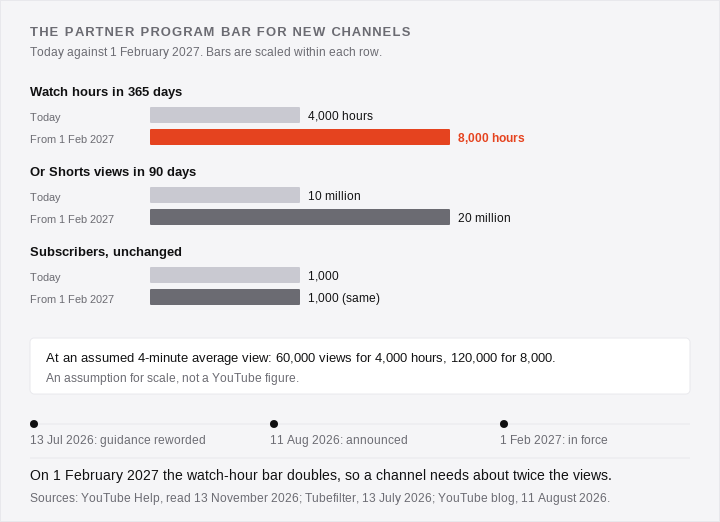
YouTube announced in August 2026 that from 1 February 2027, new applicants to its ad-revenue Partner Program need 8,000 watch hours in 365 days or 20 million Shorts views in 90 days, plus 1,000 subscribers.
Existing members are unaffected.
What the 8,000-Hour Bar Costs an Outsourced Channel
Watch hours are the total time viewers spent watching your videos. 8,000 hours × 60 = 480,000 minutes. At an illustrative 4-minute average view, my assumption and not a YouTube figure, that is 120,000 views.
The old 4,000 hours implied 60,000 views. So a paid channel needs roughly twice the videos before its first ad dollar, if each draws the same views.
- Today: 1,000 subscribers plus 4,000 watch hours in 12 months, or 10 million Shorts views in 90 days.
- From 1 February 2027: 8,000 hours, or 20 million Shorts views.
The July 2026 Guidance Was a Rewording
On 13 July 2026 YouTube regrouped its inauthentic-content guidance into three categories. Tubefilter calls it a communications update, not a new rule.
The policy page's newest logged change is still 15 July 2025, and I found no newer official change as of 13 November 2026. The faceless format post covers the January 2026 channel removals.
When YouTube Automation Is a Business and When You Have Bought Yourself a Job
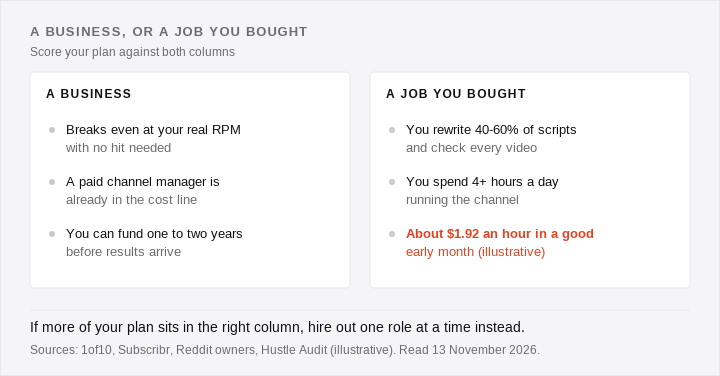
I think YouTube automation is a business only when it pays at your real RPM after you pay someone for your hours. Hustle Audit's illustrative model of a good early month works out to about $1.92 an hour.
Signs You Have Bought Yourself a Job
- You rewrite 40-60% of scripts and review every video, as 1of10 describes.
- You spend 4+ hours a day on it (Reddit owner).
- One operator says almost all the channels he worked with lost money.
- Another says he has seen 12+ hire-a-team channels fail.
Signs It Is a Business
- It breaks even at your real RPM without a hit, using the sum above.
- A paid channel manager is already in your cost line.
- You can fund the one to two years before significant results that the vendor Subscribr describes.
- Strategist Paddy Galloway, who says he sells no automation, says it can work but he would not recommend it to beginners.
Our Outlier Study Says Not to Budget for Hits
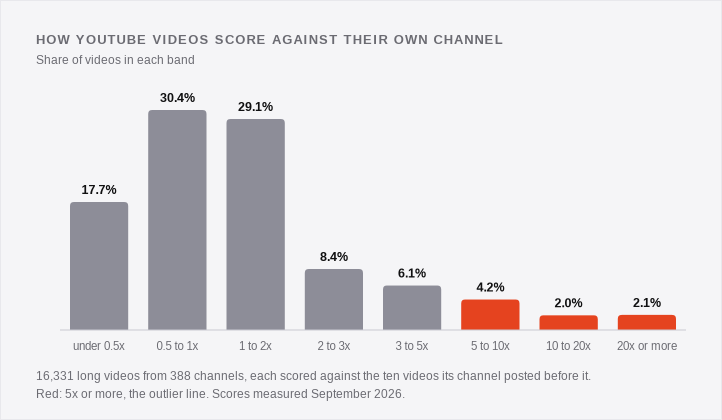
In our outlier study, about 1 in 12 long videos (8.3% of 16,331) hit 5x, meaning five times their channel's normal views. I calculated from the study's videos.csv that 17.7% drew under half their normal.
Of 131 channels with no 5x video in their older half, 41.2% got one later, against 73.1% if it were pure luck (outliers and luck). The study cannot see costs or which channels outsource.
Related: YouTube money calculator, RPM by niche and monetization checker.
Conclusion (What I Would Do)
I think YouTube automation is worth it as outsourcing on a channel that already earns, and not as a business bought from zero. Here is what I would do.
- Outsource one role, not the channel: a thumbnail (about $18 a job, unconfirmed), or one edit at $150-$600.
- Run the break-even sum with your own RPM from YouTube Studio before any bigger hire.
- Check those uploads against your channel's normal with the outlier score, a video's views set against your usual.
- If you are not yet in the Partner Program, aim to apply before 1 February 2027, while 4,000 hours still applies.
Get a weekly breakdown.
FAQ: YouTube Automation
Can you get banned for using YouTube automation?
Outsourcing itself is not banned. YouTube's policy withholds monetisation from templated mass production and AI personas posing as human experts. TNW reported 16 channels terminated in January 2026.
Do I need to disclose AI voiceovers on YouTube?
A label alone does not change how a video is recommended or whether it can earn, YouTube says. Since May 2026 it can add one itself for undisclosed photorealistic AI. I could not verify a voiceover-specific rule.
How long does YouTube automation take to make money?
Slowly. 1of10, a vendor, estimates 4-8 months to Partner Program eligibility and 8-18 months to $1,000-$2,000 a month. One creator monetised at 8 months with 7,200 watch hours.
Is YouTube Shorts automation worth it?
Shorts pay from a shared pool at 45% of allocated revenue. From February 2027 a channel needs 10 million Shorts views in 90 days to share it.
Can AI tools replace the freelancers?
Partly, and it is cheaper, not work-free. 1of10 puts an AI-first channel at $100-$300 a month. Devon Canup, who sells automation services, calls AI-only tools garbage and says channels are 90% human-made.
Has anyone actually made money with YouTube automation?
Yes, at least one network has. Fortune checked payout records at about $700,000 a year gross for a network run by Adavia Davis, who sells a course. Every other success claim I found is unverified or from a seller.